Cornelian Cherry is undoubtedly one of the easiest fruit you can grow in a temperate climate. The plants produce a reliable crop of delicious fruits year in - year out, have close to zero pest and disease pressure, and appear to get on very well with a vast range of other plants making it an excellent option for growing in polycultures. Include the splendid display of the bright yellow flowers, often laden by bees, that cheer up late winter with the promise of imminent spring, and it's a wonder every garden and street is not occupied by at least one of these marvellous organisms.
 |
| Cornus mas - Cornellian Cherry - Perfect Plants for Polycultures |
Popular and well known in Eastern Europe, Cornus mas - Cornelian Cherry or European Cornel Cherry, is less known in the west of the continent and around the world, but fortunately, is enjoying a rise in popularity, and deservedly so. During this post we’ll take a close look at these incredible plants, including how to grow them, their many uses, growing them in polycultures and permaculture landscapes, and I’ll introduce some of the excellent cultivars that we are offering from the bio nursery this season.
Overview
Cornel is an older form of the word Cornus, the Dogwood genus, consisting of 40–70 species of woody plants in the family Cornaceae. They are mostly hermaphroditic shrubs and small trees widely distributed in the temperate and subtropical regions of the Northern Hemisphere. Most of the species in this genus have edible fruits however the majority are very small or tasteless with the exception of Cornus mas and its East Asian relatives Cornus kousa - Korean Dogwood and Cornus officinalis - Japanese Cornelian Cherry. Cornus kousa is a remarkable plant in its own right and perhaps the topic of another post. I've not grown Cornus officinalis - Japanese Cornelian Cherry neither have I seen it growing but from what I can gather it's a Ringo to the Lennon that is Cornus mas. I love Ringo too :)
Cornelian Cherry - Cornus mas
Latin name - Cornus mas
Common name - Cornelian cherry, Dogwood, Cornel Cherry
Family - Cornaceae
History - C.mas has been used for centuries for medicinal and food purposes, eaten fresh, and lends itself incredibly well to processing. The plants and fruits of Cornus are well regarded in classical literature, notably, the Roman poet Ovid mentions the fruits of Cornus mas in The Metamorphoses as he describes the Golden Age, a supposed place and time when the wild and intellect were harmoniously aligned and all humans were good.
'And Earth, untroubled,
Unharmed by hoe or ploughshare, brought forth all
Those men had a need for, and those men were happy
Gathering berries from the mountainsides,
Cornel cherries, or blackcaps, and edible acorns.'
This plant has played a significant role in our ancestor's industrial and war activity. The wood is extremely tough and has been used for millennia to make objects that can withstand a lot of use and pressure, objects such as arrow and spearheads and cogs used in water and windmills. Pausanias, Greek traveler, and geographer of the second century AD reports that the legendary Trojan Horse gifted to Troy by the invading Greek armies may have been constructed of cornel-cherry wood. It's thought by some scholars that the Troyan Horse was most probably a battling ram rather than a woodcrafted horse so it seems likely they would have built it from Cornus mas, the toughest wood that grows in that region.
Given its unique tasting fruits and striking appearance, Cornellian Cherry quickly spread across the classical world. In 1551, records indicate that a specimen tree was grown in the gardens at Hampton Court Palace, UK.
Growing range - A native to Eurasia from central and southern Europe (Pyrenees, France, Italy, and the Balkan Peninsula) to Turkey and Georgia. It is now commonly found all over Europe, having been exported and naturalized outside its native regions.
 |
| Plot distribution and simplified chorology map for Cornus mas.
Frequency of Cornus mas occurrences within the field observations as
reported by the National Forest Inventories. The chorology of the native
spatial range for C. mas is derived after Meusel and Jäger6. From ec.europa |
Description - Growing at a slow - medium rate, C.mas is a small tree or deciduous shrub growing up to 5 m in height and 5m in width, although I have observed some specimens as tall as 7m. the plant is often pruned, via lifting lower limbs, to grow as a tree with the crown forming a rounded shape. The branches are densely ramified. The trunk is usually short and straight with showy exfoliating bark.

It's an attractive plant, with delicate yellow flowers that capture your attention because of their early bloom time, typically in late February. These early blooms don't go unnoticed by the insect population either and attract bees and flies straight away and in large numbers. In fact, you could identify a C.mas tree by sound rather than sight at this time of year, as the bees hum away happily, gorging on one of the first food sources of the spring. The fruits are like red olives, and very astringent unless eaten when they are very ripe - at which time they are quite delicious and packed full of Vitamin C. Leaves are opposite, simple, and have visible parallel veins. Autumn colours are pleasant with tones of green, yellow, and some mahogany red.
Sexual Reproduction - The species is hermaphrodite (has both male and female organs) and is pollinated by bees. As is typical of many fruit trees, having another cultivar growing nearby should enhance the fruit set. Plants grown from seed make excellent pollination partners to grafted cultivars and vice versa.
 |
| Hemaproditic flowers of Cornus mas |
Light Preferences - C.mas prefers full sun and will fruit better there, but it grows well in partial shade and can even tolerate significant shade. I've found plenty of these plants growing in deep shade in the forest around us. They grow much smaller than their siblings in the area with more light but, remarkably, still produce fruits, albeit fewer and smaller in size.
Water needs - C.mas is drought very drought tolerant. Last year we had at least 12 weeks without significant rainfall and daily temperatures of about or above 30 degrees centigrade and I observed a young tree (3 years old) that had been missed out when watering starting to show signs of water stress in the 9th week under those conditions. Of course, for optimum fruit production, the tree needs more regular watering. The soil should be free draining and the plants will not grow well in waterlogged soils.
Habitat and Biodiversity - The flowers are hugely attractive to a wide range of beneficial organisms and importantly, several species of bees including honey bees and bumblebees, providing an early source of nectar. Birds are also extremely attracted to the blooming tree, and you can spot several species in it year-round, but particularly on flowering.
Hardiness - USDA 4 - 8 -
C.mas tolerates wind and frost well, and it can survive up to -30, something that we have witnessed first hand. Our favourite specimen is the mature tree in our home garden, which must be at least 30 years old and has definitely experienced its fair share of Bulgarian winters. Speaking of age, while researching this blog I found two reports of a surviving tree of around 300 years. Optimum fruit production is typically for 60 years of the tree's life.
Where to Plant
Climatic Limitations - C.mas have proved to be highly adaptable to a wide range of climate conditions, from sea level up to 1500m in the Alps of Switzerland. It prefers and produces the best fruit in full sun, is thought to prefer thriving in open areas although also being surprisingly tolerant of semi-shade vegetation, such as forest edges and light woodland. Frosts and cold spells are also well tolerated but salt or maritime exposure is not.
Soil - Prefers moist, well-drained alkaline soils rich in nutrients, but is also found growing in all soil types from light sandy to heavy clay, with a pH ranging from slightly acid to very alkaline.
C.mas is really very versatile!
Location - C.mas offers many great opportunities in garden design because it is so agreeable to a variety of conditions. If you are growing the tree primarily for fruit production, you will need to consider how you plan to harvest. The fruit starts to drop, but ripens slowly and at different times. We use a net and stand underneath the tree a couple of weeks after the first fruit falls and vigorously shake the branches. This procedure requires plenty of space around the tree.
 |
| Cornus mas tree on the boundary of our vegetable garden. |
If you would only like to eat a little of the fruit choose a location away from pathways as the trees will be dropping fruit from late August - mid October and can be slippery as the fruits quickly soften to a gel once they have fallen. For optimal production choose a bright location with at least half a day of sun and place in a location that can be irrigated during hot and dry summers.
Pollination/Fertilisation - Apparently 'mas' in Latin means male, and C.mas is so-called because young trees only produce male flowers. The flowers only become "perfect" (with both male and female parts) later in maturity. In our experience, C.mas plants generally start bearing fruit in the fourth-fifth year when grown from seed. Grafted cultivars will start bearing fruit within 2 years. We always experienced excellent fruit set on our trees and this is likely because we live in an area where C.mas trees are abundant in the wild. Plant your tree with more than two pollination partners to ensure a good fruit set, you can find more details on pollination partners below when we look at our cultivars on offer.
Feeding, Irrigation, and Care
Feeding - Most trees do well without feeding once established, but when planting out we always add 20 -30 L of compost to the soil surface and a thick layer of straw mulch on top of the compost. It's good to pull the mulch 10 -15 cm away from the trunk during the winter to keep moisture from accumulating next to the trunk and rotting the collar. We'll add 20 -30 L of compost for the next 3 or 4 seasons.
Planting - We've planted trees in Autumn and in the Spring and all have taken well but probably the optimum time to plant Cornus mas is in Autumn as Cornus mas breaks dormancy earlier and it will likely be less stressful for the plant to be moved when it is dormant.
If you are planting different cultivars close by for pollination purposes, space within 10 m of each other. Once planted, The plant needs time to develop its dense and centered root system. Fruiting should begin in the third or fourth year. For a more detailed planting out guide see our link
here.
Weeding - Mulching plants with a 10 -20 cm deep layer each spring, and pulling weeds that start to grow through in the summer is good practice when the plants are young. As the trees mature, they grow well among other plants of all kinds and weeding is not necessary as a standard practice.
Pruning -
C.mas takes well to pruning all year round, and will produce fruits and flowers internally on mature plants regardless of when you prune. How you prune your plant may also depend upon its chosen use in your landscape. If you would like the plant to take on the form of a tree, you will need to remove one or two of the lower branches every year for a few years, until you see the desired shape forming along with a definitive main trunk.
C.mas naturally will take on the shape of a shrub if untouched. as it tends to develop side shoots below or even new suckers from the base. These suckers should be removed from grafted varieties as they likely come from the original rootstock. The plants also take well to Espalier an ancient agricultural practice of controlling woody plant growth for the production of fruit, by pruning and tying branches to a frame.
Harvesting - The red-fruited cultivars (there are also yellow ones) usually will turn dark maroon color and begin to start falling in late August/early September and can go on for as long as late October in our climate. I have noticed variations of a week or two depending on the climatic factors and how hot and dry the summer has been. Cornellian Cherries are one of those fruits where the perfectly ripe window is very narrow. Harvest too early and the fruits are literally repulsive, harvest too late and they can be sour and messy to handle. When the fruits are ripe they will soften when squeezed gently and the pedicel will break away from the fruit easily. Often, when the fruits fall off the tree they are perfectly ripe. Onc eat the ripe stage they will keep well for just a few days in the fridge. You can pick them when almost ripe and they will ripen in the bowl on the windowsill or in the fridge.
For harvesting large quantities of fruits nets are probably the best option. Once the fruit has been falling for a week or 2 and plenty of it has turned the deep maroon, we stand underneath the tree with a large net and shake the branches to release more of the ripened fruit and will repeat this every few weeks.
Propagation - You can propagate from seed, but there is no telling what the fruit will be like so grafting is the most common method of propagation for these plants. You can use the seed to grow rootstock and this is the most common rootstock used for all cultivars. Seed should be cold stratified for 3 - 4 months and sown as early as possible in the year.
Irrigation - In climates where you have long hot summers, if you would like to receive good fruit production you will need to irrigate your trees. Approx 30L of water applied to young trees every few weeks without rain will be adequate. In the below photo you can see two Cornelian Cherry - Cornus mas trees from our gardens. The photos were taken the same day with the photo on the left showing a tree in a hedgerow that we do not apply irrigation to and the plant on the right located beside an irrigation channel that is filled every week in the high summer.
Potential Problems
Pests, Disease, Problems -
C.mas are renowned for virtually pretty disease and pest-free, and in the 15+ years that we've grown them in a variety of settings they seem to be one of the strongest plants going. However, there are a few pests and diseases that they may fall prey to listed here
- Canker - Early symptoms of dogwood canker are small and pale leaves. Initially, symptoms appear only
on the infected side of the tree but become more
general as the canker enlarges. Canker is usually exacerbated by overly wet conditions in soils that are not free draining. As tolerant as the plant is, it cannot tolerate water logged soils.
- Anthracnose, a fungal disease with leaf spots. Other Dogwoods are more heavily affected then C.mas.
- Can be susceptible to leaf scorch during hot, dry and windy weather, as we often experience in our location. This condition can look like a disease, causing browning and drying of the leaf margins and premature leaf fall. This affects our Cornus kousa trees a lot more than our Cornus mas trees.
- The plants do not farewell exposed to salt-laden winds or in saline soils
Cornelian Cherry Uses
Fruit - If you're new to Cornelian Cherries, it won't take long for you to learn when the fruit is ripe! This is due to the fact that the unripe fruit is astringent and sour, and quite frankly, inedible. However, once it is ripe and soft to touch, it is very juicy and has quite a surprisingly pleasant flavour although still on the tart side and makes an excellent cordial, the recipe for which I'll write later on in this post. In the Balkans, fresh fruits can be used for making Rakia or Vodka, which is popular in some regions of the Balkans. I'd like to experiment making a jam or jelly to accompany all the duck we've had this year, but it's interesting that commercially, Cornelian Cherry hasn't really taken off.

While researching this post, I found a really
interesting paper about the health properties of
C.mas which concentrates on Polish cultivars of the plant, but I can't think there are huge variations.
C.mas fruit is relatively abundant in vitamin C, containing more than other popular fruits such as strawberries and even lemons with its amount ranging from 34–100 mg/100 g fresh weight. The study found that the minerals present in the largest quantities included potassium, sodium, magnesium, iron, phosphorus and sulphur. The anthocyanins present cornelian cherry fruit have antioxidant and anti-infammatory properties. See the table below.
Wood -
The Wood Database provides some useful information, and recognizes
Cornus as being one of the hardest domestic woods of the US & Canada with excellent shock resistance. However, it isn't very durable in comparison to other hardwood species such as Oak.
Erosion control - Potentially really useful. It forms a rich root
system, stabilises the soil on slopes and prevents
erosion.
C.mas can grow in altitudes of up to 1400 metres.
Animal Fodder - Generally, animals seldom eat or damage newly planted specimens, although we have used the twigs to feed rabbits and goats before. The fruit is a good source of food for birds and other wild animals.
Leaves - The leaves are opposite with a short stalk, oval in shape and usually 3-5cm wide and 6-8cm long. They have distinctive parallel veins and turn to mahogany red in autumn.
 |
| Our Cornus mas tree in mid-Autumn |
Biodiversity - One of the earliest trees to flower, attracting a wide range of pollen and nectar feeding invertebrates from Feb - March. We often see Great Tits, Blue Tits and Long Tailed Tits in our trees during the winter. I'm not sure whether they are feeding on the buds, dried fruit or perhaps the invertebrates sheltering under the crevices in the exfoliating bark.
Hedging - A most excellent hedging plant, slowly growing to form dense hedging that provides habitat, and often deep within the hedge, some fruit, for birds. Plants grown from seedlings provide excellent hedging stock. For this, space about 1.5 m apart and allow them to grow naturally for the first few years. Once the hedge has reached your desired proportion it can be maintained using a hedge trimmer.
 |
| Cornus mas Hedge - Photo from Nova |
Medicinal uses - As with other red and black fruits such as blueberries, many studies commonly attribute the health properties of Cornelian Cherries to their anthocyanin content, a beneficial plant pigment that gives fruit and veg their deep red, purple or blue hues. Previous research has linked anthocyanins to a wide variety of health claims including increased longevity, cardiovascular health, cancer prevention and dementia.
PFAF describes the fruit is a good treatment for bowel complaints and fevers, whilst it is also used in the treatment of cholera. The flowers are used in the treatment of diarrhoea and in our region, also the fruit.
Welcome to our
Online Store where you can find Forest Garden/ Permaculture plants, seeds, bulbs and
Polyculture multi-packs along with digital goods and services such as
Online Courses, Webinars,
eBooks, and Online Consultancy. We hope you enjoy the store and find something you like :) It's your purchases that keep our Project going. Yuu can also find our full list of trees. shrubs and herbs for forest gardens on our
website here Cornelian Cherry Yields
I would estimate that we harvest at least 50kg of fruit from our oldest tree in the residential garden. According to some studies, in its natural habitat, the Comelian cherry can yield from 500 to 1000 kg of fruit per hectare but, in orchard plantings, fruit yields can reach up to 5000 kg per hectare. This gives the species huge potential.
In the past decades, the Department of Breeding
and Propagation of Garden Plants, Faculty of
Horticulture, Mendel University in Brno, located in Žabčice, Czech Republic, have been experimenting with some selective, less known trees with high ecological value, including
C.mas, looking specifically at growth parameters, commercial viability and phenology. It's great work and you can read more about it
here.
Regenerative Landscape Design - Online Interactive Course
Want to learn how to design, build and manage regenerative landscapes? Join us on our Regenerative Landscape Design - Online Interactive Course.
The course includes 20 lessons, with 20 hours of one-to-one mentoring/consultancy, drawn from over 20 years of experience designing, implementing and managing polyculture gardens, farms, food forests and regenerative landscapes across a variety of climate zones.
We look forward to providing you with the confidence, inspiration, and opportunity to design, build and manage landscapes that produce food and other resources for humans while enhancing biodiversity.
You can access all of the course material without the one-to-one tutoring by becoming a paid annual subscriber to our Substack, which grants you access to the Bloom Room for just 70 USD per year. Subscribe below to join now.
I look forward to having you join us!
Cornelian Cherry Polycultures
C.mas features in our
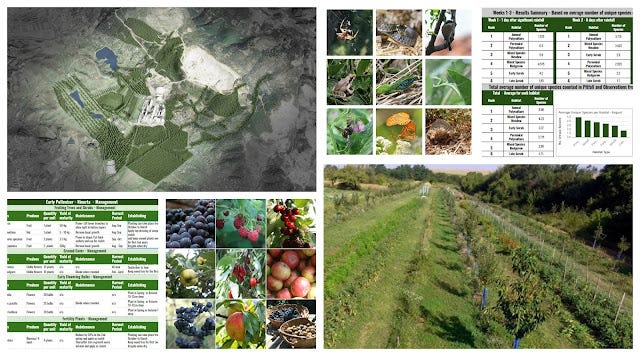
Early Polleniser Polyculture - Ninurta. As the title suggests the primary purpose of the Early Polleniser Polyculture is to provide an early source of pollen/nectar to a wide diversity of pollinating insects. The majority of the plants in this polyculture bloom when there is little other sources of nectar/pollen available. This encourages pollinating insects in and around our gardens to fulfill their vital role when the crops (particularly fruit trees) start to flower in the early spring.

Design Variations - The plants and habitat in this polyculture can be assembled in many ways. You can consider the plants and habitat listed above as a "palette" from which you can create many forms. Here are a few variations on the design for where space is limited.
The first design is a 20 m2 circle with all of the plantings fitting under the mature canopy of the Cornus mas. It's very similar to the first early polleniser polyculture I designed during the development of a 5 ha polyculture/permaculture orchard I was working on a few years ago. The plan was to include some early forage perennials and habitat for bees and other pollinators to support the fruit trees and shrubs, and I was pondering how best to integrate these plants. As the design developed it turned out there were odd spaces where the tree alleys converged with access tracks and the headlands. The spaces were not big enough for fruit trees to fit without blocking access. They were quite evenly dispersed across the site and seemed perfect for placing the polyculture.

The plants can also be planted denser for hedgerow plantings and subdivision hedges. The following planting scheme would work well for hedging with a 20 cm strip of flowering bulbs and ground cover running parallel with the hedge. The Cornelian Cherry and Hazelnuts may be left to grow out.

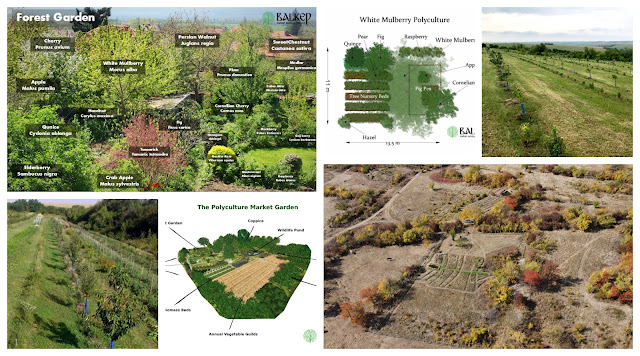
In 2018 we started a 3 year experiment in order to discover the properties of perennial polycultures. specifically, we're looking at: how productive polycultures can be, what effect polycultures have on the soil (the physical, mineral and biological properties), the relationship between polyculture and biodiversity, the setup and running costs of the polyculture (in time, money and materials and how much fertility we can produce within the polyculture without external inputs. C.mas was one of the species used in our productive polyculture beds here with Eleagnus umbellata. We'll be adding herbs and bulbs into the bed as the plants mature and intend to keep the Eleagnus umbellata shrubs pruned to 1m high 1m wide and use the nitrogen rich trimmings to mulch the Cornus mas.
For more on our Perennial Polyculture Trials see
here
We are growing three Bulgarian cultivars of Cornellian Cherry in this particular trial;
We also have these cultivars available from the nursery and you can find out more about these plants in the section below.
Cornus mas Cultivars — Hardy and Resistant to Major Pests and Diseases from our Nursery.
We have a small selection of local cultivars that are high yielding with an excellent taste, and virtually resistant to disease and pests. Our plants are 2nd year on the graft bare roots with an approximate height of 60- 80cm (depending on cultivar). €14 per tree, with delivery available from late November - late March, to pretty much anywhere in Europe.
Email balkanecologyproject@gmail.com to place an order.
Cornelian Cherry - Cornus mas 'Pancharevski'
Description - Large, cylindrical, bright red fruits with a nice gloss and bright red juice.
Fruiting Period - Aug - Early Sep
Storage - 5 -10 days with refrigeration
Pollination -Pollinated by bees - partially self-fertile, better fruit production with two cultivars
Disease Resistance -No pest or disease problems
Form - The trees grow moderately fast have form flat wide crown.
Root stock -Grown on wild Cornus mas roots
Cornelian Cherry - Cornus mas 'Shumenski''
Description - Fruits are very large, oblong. Their skin is red to dark red with a nice gloss and purple juice with a pleasant aroma.
Fruiting Period - Late August
Storage - 5 -10 days with refrigeration
Pollination -Pollinated by bees - partially self fertile, better fruit production with two cultivars
Disease Resistance -No pest or disease problems
Form - The trees grow moderately fast have form flat wide crown.
Root stock -Grown on wild Cornus mas roots
Cornelian Cherry - Cornus mas 'Kazanlashki''
Description - -The fruits of this variety are very large pear shaped, red to dark red with a nice glossy and crimson juice.
Fruiting Period - Early September
Storage - 5 -10 days with refrigeration
Pollination -Pollinated by bees - partially self fertile, better fruit production with two cultivars
Disease Resistance -No pest or disease problems
Form - The trees grow moderately fast have form flat wide crown.
Rootstock -Grown on wild Cornus mas roots
I'll end the post with a recipe for making Cordial that is very popular in our region and something we often make in late summer
Cornelian Cherry Cordial Recipe
-Prepare by washing glass jars and bottles well and leaving them to dry.
-Harvest the ripe fruit by holding a sheet under the branches of the tree and shaking them gently. Gather them into a large bucket and rinse with cold water to remove other tree debris.
-Weigh the fruit to know how much sugar should be added. It's all according to personal preference and how sweet the fruit is, but as a general guide, 300-500g sugar for every 1kg of fruit.
-Place the fruit into a large saucepan and bring to a gentle boil for around 30 minutes, with the lid allowing a little steam to escape. Allow cooling.
- Use a piece of cheesecloth (we use a pillowcase) and strain the mixture through it, squeezing the life out of the pulp and seeds, which can then be composted.
- Bring the red liquid back to a gentle simmer, and add the sugar, stirring until well dissolved. Remember, this is a syrup, so you can test for sweetness by pouring a little of the liquid into a glass and diluting it to taste. syrup:water (1:5)
Once you are satisfied with the sweetness levels, you can pour the syrup into the glass jars and bottle while still quite hot, seal and leave them to form their own vacuum.
Enjoy!
Support Our Project
If you appreciate the work we are doing you can show your support in several ways.