
I finally managed to exit Istanbul to continue my eastward journey, it's only been days since I left the city but the landscape I've arrived in makes it feel like a lifetime ago. Travelling somehow distorts time, turning days into weeks, weeks into years and when you arrive back to where you started, it all shrinks into distant memories. Anyway, during this post, I'll be writing about Cappadocia, specifically the Göreme Valley, taking a look at some of the marvelous wild plants I've encountered and some of the local plantings around the settlements in the region.

One of the most striking features of Cappadocia is the bizarre shape of the land, specifically the world-famous "fairy chimneys". The chimneys are a result of a geologic process that began millions of years ago when volcanic eruptions rained ash across the land. That ash hardened into tuff, a porous rock, which was covered by a layer of basalt. Finally, the long work of erosion sculpted the landscape in a fashion Gaudi and Dali would be proud to sign their names on.

The land has been used as a residential area by humans throughout history, the rock being easy to carve, it provided excellent caves for people to shelter in. I stayed in a place called Göreme that has been a human settlement since at least 1800 BC, probably much longer, and features prominently in the ancient and classical history of Persia, Greece, and Rome (to name but a few).

Nowadays the town is a tourist hotspot offering hot air balloon rides that fill the skies at dawn, ATV trails, and horse and camel trekking. I wonder what the ancient people would make of it if they could magically teleport into the now?

Although the land looks desolate, when you get into the landscape the plant diversity is quite impressive and 114 endemic species can be found in this region, mostly grassy steppe plants but also some tree species including Wild Almond and Hawthorn.

I'm not sure of the species but I found a number of Hawthorn, Crataegus spp. with relatively huge fruits compared to the plants I'm used to seeing. The fruits that can be seen in the below photos were at least 2cm in diameter.


Some of the plants are outstandingly beautiful but don't let their dainty and delicate facade fool you, these plants are some of the toughest on the planet, dealing with extreme heat and cold, wind, lack of water, and hungry herbivores. Many of these plants deal with this by hugging the ground, taking on a cushion-like appearance. They keep their leaves small, thick, and waxy and often have spines and thorns that take them off the salad menu for the majority of herbivorous mammals. My personal favorite was Acantholimon sp. possibly Acantholimon ulicinum (photo below). The genus name comes from the Greek akantha meaning a thorn.

As you wander around the small valleys of Göreme or in the gorges of Ihlara or Soganlś you will find a wealth of edible plants including Juglans regia - Persian Walnut, Vitis vinifera cv. - Grape, Prunus armeniaca - Apricot, Cydonia oblonga - Quince and vegetables growing in the gardens and allotments. At first, I was surprised to see productive plants growing in the area and even more surprised to see how healthy and vigorous the plants were. I have since learned that the volcanic tufa soil is extremely fertile and the porosity of the soil soaks up rainfall and stores the water deep in the soil where the plants can access it. Many of the vineyards and orchards, included those photographed below, are not irrigated at all.

For vegetable production, a guano produced by the local population of Rock Pigeon Columba livia is also mixed with the soil making it possible to cultivate a wide range of vegetables that are grown in small gardens. The below photo on the left was taken in Pigeon Valley a short drive away from the center of Göreme, where many Rock Pigeon Columba livia reside. The photo on the right is of a store in the town where the owner, Faruk, is growing tomatoes in wicker baskets filled with tufa soil, guano, and sheep manure. He waters the plants every few weeks, changes the growing medium every 2 or 3 years, and gets a decent annual yield of tomatoes that ripen in August.


As with pretty much every village, town, and city I've visited in Turkey, in Göreme special care and attention is given to street plantings in the central areas. This included a large diversity of evergreen trees, deciduous broadleafs, climbers ground covers, herbs, and a variety of fruit and nut trees. One species I was really pleased to see was Morus nigra - Black Mulberry that had the most delicious fruit. Unlike the Morus alba - White Mulberry , the fruits of Morus nigra - Black Mulberry have a tinge of sourness and are juicy to the point that the purple juice explodes out of them when picking and eating. The juice will stain your fingers, clothes, and the pavement beneath the tree, as you can see in the below image.


Another interesting observation was the Vitis vinifera cv. - Grape, growing up the pine trees. Much of the fruit was growing high in the canopy and not really a problem with the pine still being young.

Support Our Project
If you appreciate the work we are doing you can show your support in several ways.
Become a member of the Bloom Room with a $70 annual subscription to our Substack where you can access the content in our Regenerative Landscape Design Course , a member forum and more.
Make a purchase of plants or seeds from our Nursery or Online Store
Join us for one of our Onsite or Online Courses
Comment, like, and share our content. Sharing is caring !

Regenerative Landscape Design - Online Interactive Course
Want to learn how to design, build and manage regenerative landscapes? Join us on our Regenerative Landscape Design - Online Interactive Course.
The course includes 20 lessons, with 20 hours of one-to-one mentoring/consultancy, drawn from over 20 years of experience designing, implementing and managing polyculture gardens, farms, food forests and regenerative landscapes across a variety of climate zones.
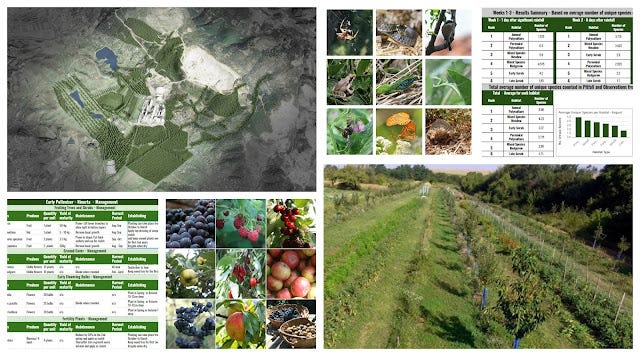
We look forward to providing you with the confidence, inspiration, and opportunity to design, build and manage landscapes that produce food and other resources for humans while enhancing biodiversity.
You can access all of the course material without the one-to-one tutoring by becoming a paid annual subscriber to our Substack, which grants you access to the Bloom Room for just 70 USD per year. Subscribe below to join now.
I look forward to having you join us!
Resources
The History of Cappadocia : https://taskonaklar.com/blog/the-history-of-cappadocia/
For more on the ecology of Cappadocia see here
Birds, Wildlife and History http://www.cappadociaexplorer.com/en/detay.php?id=38&cid=48

Thank you for taking the time to show and describe all the plants you encounter and the voyage pics :)
ReplyDeleteThank you
ReplyDeleteExplore the best Turkey Tour Packages with DHT Holidays, offering seamless travel experiences from India. Our Turkey Tour Packages from India include Istanbul, Cappadocia, Pamukkale, and more, covering flights, hotels, sightseeing, and guided tours. Book now for an unforgettable journey through Turkey’s rich history, vibrant culture, and breathtaking landscapes!
ReplyDelete