Friday, 5 November 2021

Still seeds, Allium bulbs and Planting Garlic - Week 22 - ESC Project - The Polyculture Project

Seed saving continues in earnest, stocking up the bionursery, sharing with friends and collecting for a local seed exchange that is being created by the ESC volunteers for the people of Shipka to use. The seed library will be housed at the Mayor's office where local food growers can access different cultivars of their favourite vegetables, try out out some new ones and add their own favourite seeds to the stock.


 The vegetables grown locally typically include potatoes, onions, carrots, beans, tomatoes, cucumbers, peppers, aubergines, courgette and winter squash, but over the last few years there has been a noticeable increase in the availability of more unusual vegetables for the area, such as parsnips and kale. Local cultivars of tomatoes are among some of the best I've tasted, and people seem very open to trying out new ones too.


Harvesting the seeds from  Hibiscus syriacus - Rose of Sharon was a fascinating process, and the empty seed pods as seen in the below image could potentially be used in crafting or to make jewellery. Hibiscus is a late flowering deciduous shrub growing to 3m in height with as much as a 2m spread. It's a highly ornamental plant with edible flowers


Seeds aren't the only thing we've been harvesting this week, as we dug up the bulbs from the Allium nursery. 

To build the raised beds where we grow the Alliums we cleared and levelled the area, built the frames with 20 cm wide pine planks and shovelled out 50 cm wide pathways between the beds using the pathway soil to fill the beds, which  finally were topped up with some top soil and compost from around the garden.

Dylan helping to create the beds with the ducks foraging for worms 

We've situated the beds in a gap between some mature cherries trees and a large Mulberry where they will receive at least 6-7 hrs a day of light during the growing season. The beds are laid out on contour so that we can use our flood irrigation system between the pathways to irrigate.

Allium sphaerocephalon - Round-Headed Leek growing in the Allium beds

The other Allims we are growing here are Allium neapolitanum - Daffodil Garlic, Allium sphaerocephalon - Round-Headed Leek, Allium atropurpureum - Dark Purple Onion and Allium moly - Golden Garlic. The bulbs are dug up and stored in lightly most sawdust before sending out to customers. We always replant the beds with some of the bulbs to ensure thee will be plants next year. 


While on the subject of bulbs, Fanny and Ruhsar from the ESC crew planted out two beds with Garlic for harvesting next year. If we have a mild autumn then the chances are that the bulbs will send out green shoots and so me decent growth on the roots. Once winter hits, the fresh green growth will die back, but the gains made by the roots as they settle into the soil means that by next spring the Garlic will have a head start and start growing more quickly than if we planted them out in the spring.


We usually plant the Garlic cloves 15cm apart and leave 15 - 20cm in between rows 

I always find planting Garlic a great starting point for an annual polyculture, as leaving adequate spacing between the rows allows for other crops to be sown directly into these spaces. We have experimented with sowing early carrots and spring onions, dill and spinach with good success. When the garlic is ready to be harvested we fill the spaces left by them with transplanted cabbage seedlings, sow beetroot or transplanted peppers. Many more combinations are probably possible. Here's a breakdown of this Polyculture.


Polyculture Name - Cleanthes
Annual - Productive Polyculture
Compatible Climate (KCC)- C - D (B with irrigation)
Water Needs - Irrigation required for optimal production
Light Preferences - Full Sun/Dappled Shade
Soil Preferences - Fertile Loam
Suitable pH: 6 - 7.5
Layout - Island - Row - BeltWelcome to our Online Store where you can find Forest Garden/ Permaculture plants, seeds, bulbs and Polyculture multi-packs along with digital goods and services such as Online Courses, Webinars, eBooks, and Online Consultancy.  We hope you enjoy the store and find something you like :) It's your purchases that keep our Project going. Yuu can also find our full list of trees. shrubs and herbs for forest gardens on our website here 


Regenerative Landscape Design - Online Interactive Course 


Want to learn how to design, build and manage regenerative landscapes?  Join us for our Regenerative Landscape Design - Online Interactive Course from May 1st to Sep 13th, 2023. 

We're super excited about running the course and look forward to providing you with the confidence, inspiration, and opportunity to design, build and manage regenerative landscapes, gardens, and farms that produce food and other resources for humans while enhancing biodiversity.

Regenerative Landscape Design Online Course

You can find out all about the course here and right now we have a 20% discount on the full enrollment fees. Just use the promo code
 RLD2023 in the section of the registration form to receive your discount. 

We are looking forward to providing you with this unique online learning experience - as far as we know, the very first of its kind. If you are thinking of reasons why you should do this course and whether this course is suitable for you, take a look here where we lay it all out. Looking forward to it!


--------------------------------------------------------------------------------------------------------------------------

We offer a diversity of plants and seeds for permaculture, forest gardens and regenerative landscapes including a range of fruit and nut cultivars. We Deliver all over Europe from Nov - March. - Give a happy plant a happy home :)


Our Bio-Nursery - Permaculture/Polyculture/ Regenerative Landscape Plants 

--------------------------------------------------------------------------------------------------------------------------

Support Our Project 


If you appreciate the work we are doing you can show your support in several ways.

  • Comment, like, and share our content on social media.
  • Donate directly via PayPal to balkanecologyproject@gmail.com or via FTX Pay


Thursday, 28 October 2021

Akebia Quinata, Grape Juice and a Spiral - Week 21 - ESC Project - The Polyculture Project


This week the Akebia Quinata fruits opened, revealing their seeds within the tropical yet other-worldly looking fruits. It was fun to present the fruits to the ESC crew and watch their surprised expressions, especially when they learnt that you can eat the white seed containing flesh. The outer purple skin is theoretically edible, but doesn't taste good in our opinion, although we've only tried it raw and I've heard that it's more palatable cooked. Although the edible white flesh is small in quantity and fiddly to eat, the taste is divinely sweet, although not chocolate like at all. The association with chocolate is likely more related to the sweet smelling purple flowers that cover the vine in early April. We save the seeds for growing new stock and also seed packs from our bionursery.

Akebia is a climbing vine or a ground cover. It comes into leaf in early spring and shortly after leafing is adorned with beautiful purple flowers. It's fast-growing and has created an incredible high cover providing much needed shade in our yard in the summer months. 

We planted it beside one of the vines in our yard but can't recommend this combination as the Akebia growth will eventually strangle the Grapevine as it matures and the Akebia, while not being pruned every year, is starting to dominate the arbour and reducing the light the vine receives and very few grapes grow in this area now.


This week with the ESC crew we extended and made improvements to a central spiral feature in the central community garden area.

 The volunteers have been helping to maintain this garden throughout the summer, and it was nice to finally lay the stones into the spiral as this completed one of the first tasks that was started on back in the spring. We waited until the autumn so that the soil was nice and moist, making it easy to lay the stones and ideal conditions for incoming plants.

Before

After
Welcome to our Online Store where you can find Forest Garden/ Permaculture plants, seeds, bulbs and Polyculture multi-packs along with digital goods and services such as Online Courses, Webinars, eBooks, and Online Consultancy.  We hope you enjoy the store and find something you like :) It's your purchases that keep our Project going. Yuu can also find our full list of trees. shrubs and herbs for forest gardens on our website here 


The area is in pretty deep shade in the summer and also under pine trees so it may be acidic. We selected the following plants to fill out the space; 

Mentha spp - Mint  We were given some divided plants by a local elderly lady and there are already several established plants doing well in this area. Borderline hardy to zone 6/7, the flowers attracting butterflies and bees and they grow well in the shade. 

Ajuga repans - Bugle  is an evergreen perennial hardy to zone 3 that makes an excellent ground cover plant, forming a mat of glossy edible leaves. The flowers are favoured by bees and the dense mat formed by the plants provide shelter for many beneficial organisms. It can grow well in the shade.

Spotted Purple Nettle makes excellent ground cover, quickly forming a dense mat. Hardy to zone 3, it can tolerate deep shade and it's flowers attract a wide range of beneficial organisms. 


From L top clockwise - Ajuga, Lamium & Mentha


A full day was spent this week harvesting grapes and processing them into juice. After a week of heavy rain the sugar content was significantly lower which actually resulted in a juice of perfect sweetness.

One the grapes are picked you lay them on a plastic sheet or a yoga mat (!) and use a hose to wash them down. 

The 'wash down' pose

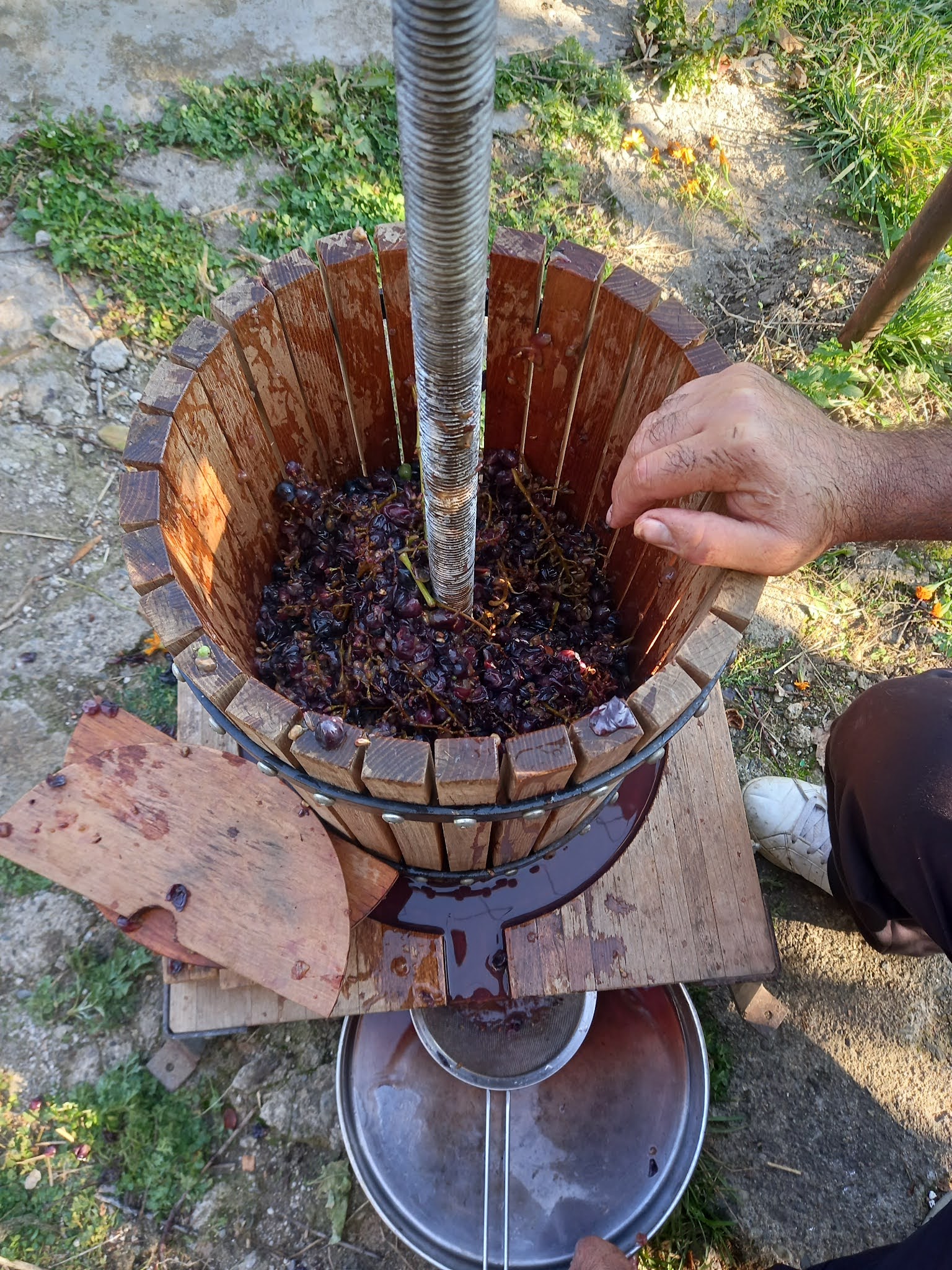
Next step is to put entire bunches of washed grapes through the mangle, which as the name suggests crushes the grapes, and catches the juice and pulp in a large plastic barrel, known locally as a 'bidon'.


Once the plastic container is full, start moving the pulp over to the press for a final squeeze. We ran the juice through a sieve to remove any solid parts. Then the juice is ready for bottling up.


By the end of the day we were all feeling a bit giddy - must be all that grape juice ;)


Since we have never had much success with winemaking thus far, we tend to always make a lot of grape juice and freeze it. This year we tried to store some in jars as well, creating a vacuum seal using a water bath.


The leftover material consists of skins, pulp, seeds, stems, leaves, and other residue. This was removed from the press and placed directly onto newly created garden beds. It makes excellent mulch as it is nutrient dense and acts as a slow release fertilizer. We covered the material with autumn leaves to avoid attracting wasps to the area.


Thanks to the ESC crew for some of the photos used in this blog. You can check out the ESC volunteer's personal blog here.  


Regenerative Landscape Design - Online Interactive Course 


Want to learn how to design, build and manage regenerative landscapes?  Join us for our Regenerative Landscape Design - Online Interactive Course from May 1st to Sep 13th, 2023. 

We're super excited about running the course and look forward to providing you with the confidence, inspiration, and opportunity to design, build and manage regenerative landscapes, gardens, and farms that produce food and other resources for humans while enhancing biodiversity.

Regenerative Landscape Design Online Course

You can find out all about the course here and right now we have a 20% discount on the full enrollment fees. Just use the promo code
 RLD2023 in the section of the registration form to receive your discount. 

We are looking forward to providing you with this unique online learning experience - as far as we know, the very first of its kind. If you are thinking of reasons why you should do this course and whether this course is suitable for you, take a look here where we lay it all out. Looking forward to it!

--------------------------------------------------------------------------------------------------------------------------

We offer a diversity of plants and seeds for permaculture, forest gardens and regenerative landscapes including a range of fruit and nut cultivars. We Deliver all over Europe from Nov - March. - Give a happy plant a happy home :)


Our Bio-Nursery - Permaculture/Polyculture/ Regenerative Landscape Plants 

--------------------------------------------------------------------------------------------------------------------------

Support Our Project 


If you appreciate the work we are doing you can show your support in several ways.

  • Comment, like, and share our content on social media.
  • Donate directly via PayPal to balkanecologyproject@gmail.com or via FTX Pay


Wednesday, 20 October 2021

Seed Saving, Heavy Rain and Plants for Autumn Colours - Week 20 - ESC Project - The Polyculture Project

This week the weather has been more like something experienced in Wales with cool temperatures and significant and persistent rainfall, quickly turning a pleasant transition into autumn into a quick dash inside to the warmth of the stove.


 Many of the end of season garden tasks have yet to be completed and the high winds have ripped some of the Sweet Chestnuts off the branches before they are fully ripe. We've spent a lot of time this week gathering up soggy walnuts from the muddy ground and drying them out inside by the fire.


The ESC volunteers made the most of the one dry morning and harvested the majority of the sun loving annual vegetables. There are still leeks, carrots and chard in their garden which can be harvested a little later on, so long as we continue to avoid frosts. The green tomatoes have since been processed into a tasty chutney, using spices brought from Istanbul to flavour.


It was a bumper harvest of squash again this year, grown from an heirloom seed we have named, 'Victoria's Granny'. The original seed came from a previous participant of The Polyculture Project, Victoria, who was given them by her grandmother in Belarus. Year on year they reliably produce enormous quantities of the most delicious tasting winter squash. As part of our ESC project, Misha from the Green School Village came up with the idea to start collecting some of the local heirloom seeds grown in Shipka and to create a seed library for the local community to use.  We've been sorting through what seeds we have as a base stock for the library, and also saving seeds from the tomatoes gifted to us by some of the local elderly people. Once the weather improves we will be asking local food growers to donate some of their favourite seeds to the library. 

Seed saved from a local variety of tomato

Translating the names into Bulgarian

The wet weather means that many of the plants suddenly seem to have developed their autumn colours with speed. Cool and windy conditions will encourage the leaves to drop, signalling the official start of the nursery season. Here are three of our favourite trees and shrubs for autumn colours that we are offering this season.

Welcome to our Online Store where you can find Forest Garden/ Permaculture plants, seeds, bulbs and Polyculture multi-packs along with digital goods and services such as Online Courses, Webinars, eBooks, and Online Consultancy.  We hope you enjoy the store and find something you like :) It's your purchases that keep our Project going. Yuu can also find our full list of trees. shrubs and herbs for forest gardens on our website here 


Rhus typhina - Stag's Horn Sumach

Overview: Hardy to Zone 4. Rhus typhina is more commonly known as Stag's Horn Sumach due to the branches being reminiscent of a stag's antlers. This interesting plant architecture is revealed once the leaves have fallen in the autumn and the tree is dormant. It is a large suckering deciduous shrub that can grow up to 8m, the red-hairy stems with large pinnate leaves turning pretty shades of red and orange in the autumn.   It can grow in a wide array of habitats and can thrive in dry and poor soil, making it a great choice for these conditions. Can also tolerate wind quite well. 


Mespilus germanica - Medlar 

Overview: Hardy to zone 6. Medlars are ornamental, flowering trees with pretty white blossom, really attractive autumn colours with different hues of red, orange and yellow and delicious late autumn/winter fruit that should be bletted before eating. They tolerate most soils and are most comfortable if planted in a sunny and sheltered position but also do well in partial shade.  A perfect candidate for the outer edge of a woodland garden and able to tolerate moderate wind. For a more detailed look at this plant see our Essential Guide to Growing Medlars.


Aronia melanocarpa cv. - Black Chokeberry

Overview: Hardy to zone 4.  Aronia is a deciduous Shrub growing to 2.5 m by 3 m. An attractive fruit bearing shrub that grows well in partial shade, making it a good option for the forest garden. Tolerates most soils and can handle moist conditions. The berries are edible  but should be fully ripe before being eaten, meaning that they are often still on the plant by the time the leaves turn a very deep red in the autumn. 


Regenerative Landscape Design - Online Interactive Course 


Want to learn how to design, build and manage regenerative landscapes?  Join us for our Regenerative Landscape Design - Online Interactive Course from May 1st to Sep 13th, 2023. 

We're super excited about running the course and look forward to providing you with the confidence, inspiration, and opportunity to design, build and manage regenerative landscapes, gardens, and farms that produce food and other resources for humans while enhancing biodiversity.

Regenerative Landscape Design Online Course

You can find out all about the course here and right now we have a 20% discount on the full enrollment fees. Just use the promo code
 RLD2023 in the section of the registration form to receive your discount. 

We are looking forward to providing you with this unique online learning experience - as far as we know, the very first of its kind. If you are thinking of reasons why you should do this course and whether this course is suitable for you, take a look here where we lay it all out. Looking forward to it!


--------------------------------------------------------------------------------------------------------------------------

We offer a diversity of plants and seeds for permaculture, forest gardens and regenerative landscapes including a range of fruit and nut cultivars. We Deliver all over Europe from Nov - March. - Give a happy plant a happy home :)


Our Bio-Nursery - Permaculture/Polyculture/ Regenerative Landscape Plants 

--------------------------------------------------------------------------------------------------------------------------

Support Our Project 


If you appreciate the work we are doing you can show your support in several ways.

  • Comment, like, and share our content on social media.
  • Donate directly via PayPal to balkanecologyproject@gmail.com or via FTX Pay