It's been a while since my last post and it feels as though within that time span everything has changed. The optimist in me believes for the better, the realist believes not without a struggle and the pessimist would not be writing anything at all. It feels as if we have all suddenly woken up from a bizarre dream but can't quite tell what's the dream and what's reality. It's certainly testing times and I hope that you are all keeping well and using this time to benefit your family, friends, and neighbours as best as possible.
So here's what we've been up to the last few weeks, and how the recent events have affected our project and what we are doing in response to what is happening right now.

I was in Istanbul for the winter writing for our online course and book. Fortunately, I managed to get back to Shipka a day before the borders shut and feel lucky to back with my family and the plants in the gardens. It's difficult to imagine how that beautiful city will cope with the pandemic but every experience I've had with the people there leads me to believe they will face it with grace and dignity.
 |
| Crossing the Bosphorous - photo by Georgi Pavlov who joined me in Istanbul for a week. |
Back in Shipka, it's been a super busy week as we work on getting our spring plant deliveries out to our customers. Most of the orders are on their way now, however, our courier is not delivering to Italy or Switzerland and the post office is only sending small packages without guaranteed tracking so we're looking for alternatives. With travel bans in place across the globe, our Polyculture Study Crew and European volunteers from the ESC scheme can't make it in April and it looks most likely that our April course and open day will not be possible under the current laws prohibiting groups of more than 2 from gathering. We're expecting that the travel bans will continue into early summer so perhaps we can pick things up in June/July. We will be running our online course starting in May and we'll be running free webinars on growing food intensively in the cities & foraging for wild plants over the next few weeks - more on that later.
Day to day life in Shipka is pretty much like it's been since we arrived 13 years ago, the people of our age and older accustomed to having to rely on the land and each other, and many people here still have fresh in their minds hyperinflation events and political collapse during the 1990's and are well equipped to take care of their basic needs. The main notable differences are that people are wearing masks, the social distancing rules in the local shops and in the nearby town of Kazanlak, and yesterday a large tanker vehicle drove through the village with two people masked up sitting on the back spraying disinfectant on the streets and pavement, a very dystopian scene. The schools have been closed but we've been home educating the boys for 8 years so that does not really make any difference to us personally. Normally when schools are off the kids and their friends take over the house but with the lockdown we've not seen any other kids the last few weeks.


Shipka
Our Plans for this Year
Our plans have changed this year and most of our trials will be put on hold as we turn our attention to grow more crops. Given the uncertainty, we're going to use this situation as an opportunity to practice a life where the regular food supplies are not reliable. Although we have set up a life here in preparation for such events with perennial crops, diverse fruit and nut trees, and healthy and fertile soil all supporting a wide diversity of wildlife, we along with probably most people on the planet all too readily take for granted the stability of our economy and supply chains. We've ordered 40 kg of potatoes from an online vendor that we'll be planting out in Ataraxia. 80 potato plants should provide up to 6 months' worth of meals for a family of four with potatoes on the menu 5 or 6 days week but we've ordered more than we need in case there is a shortage later in the year and some of our neighbors can use them. We'll also plant plenty of corn in May, and we will grow all of our regular annual crops highly concentrated in polycultures in our back garden. When the last of the spring plant orders are out of the nursery we will move the majority of the nursery plants into the market garden to make more space in the home garden for crops. The boys have already started to plant out nitrogen fixers Alnus cordata - Italian Alder and Elaeagnus angustifolia - Russian Olive in the nursery beds in Aponia. We are growing our mother Corylus avellana - Hazelnut nut trees in this bed spaced 4 meters apart and will be harvesting division from these plants for new stock (find the cultivars we are growing here). In between the hazels, we are planting patches of the above mentioned Nitrogen-fixing trees and shrubs for a year or two before they go out to our customers.

From the forest gardens, we'll be focusing on preserving fruit and nut harvests this year via drying, and preserving in jars and dipping into the wild larder as much as possible for teas and salads. We'll be getting a batch of 3-day old chicks that Dylan will take care of, that we will grow for 10 weeks and process for meat, and a couple of piglets in May. The ducks are producing eggs for us and with 2 males and 3 females we can expect an expansion of our flock this season if all goes well.
Soph and I thought it would be a good idea to take this time to press the point to our two boys Dylan and Archie not to take things for granted and how important it is to at least know how to meet your fundamental needs. We've made an agreement that when they have finished their help around the gardens and completed a daily video on living off the land they can play as much computer as they like. Dylan and Archie will be making daily videos of what they are up to, the first and second of which you can find below.
New Daily Video Series from Dylan and Archie
Day 1
Day 2
Forest Garden Plants
First blossom from a Prunus cerisifera 'Nigra' - Purple Plum we planted in the Autumn, we're looking forward to the first fruits this summer. Somewhat tarter than the usual cherry plums, just how I prefer a plum.

Often considered as a weed by gardeners, Ficaria verna, the ground cover formerly known as Ranunculus ficaria L. common name Lesser celandine, is welcome in our gardens where it forms dense mats in the understory of the forest garden. The flowers provide great early fodder for bees and the leaves can be eaten when cooked but are poisonous if ingested raw, and potentially fatal to grazing animals and livestock such as horses, cattle and sheep.

Here we have the first-ever blossom from a Prunus domestica - Plum 'Angelino' that we planted a few years back. Hopefully, the fruits will follow this July. I love the suspense of trying a new fruit for the first time, but I have noticed that with fruit cultivars the first blossoms do not always produce fruit.

Dipsacus laciniatus growth leftover from last winter. This native to Europe and Asia is a perennial herb that may grow up two to three meters in height. The erect, branching stem is hollow and prickly and although I have not investigated the inside of the stems yet it has the potential to serve as overwintering sites for invertebrates. The flowers are much loved by a wide variety of bees and we always encourage this plant to grow in our gardens.

The incredibly potent Nectaroscordum siculum - Bulgarian Honey Garlic coming up through Vinca minor - Lesser Periwinkle ground cover

Cornus mas the first trees to flower in our gardens

Scilla forbesii a bulbous perennial from west Turkey is new to our gardens and we'll be offering it from the nursery next season. Glorious little flowers!

Dylan found this beauty under a strawbale when planting out some boundary trees in the market garden.

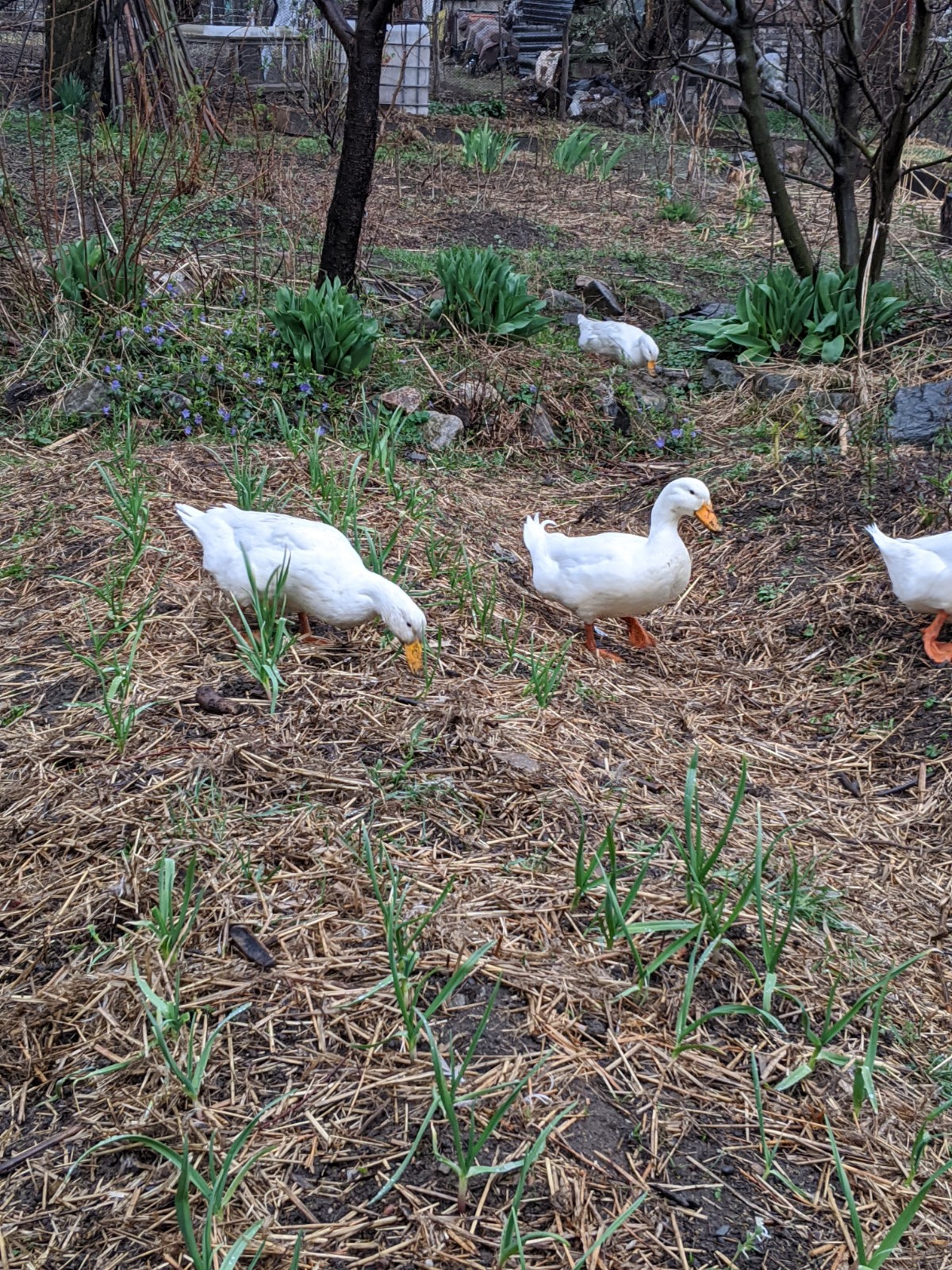
The ducks are still free-ranging around the garden and do not make any problems for the emerging garlic plants. We'll likely keep them in their pen when we start sowing the leafy greens as they are partial to the emerging seedlings.
Looking more like a Starfish at the moment than a plant, this is one of the new Allium plants we are growing for the nursery and around the gardens. Allium atropurpureum is native to our region and a popular ornamental given its beautiful flower.

Allium sativum planted by the boys a few months ago will be ready for pulling and drying in late June.

Forsythia x intermedia a common ornamental shrub and a native to Bulgaria and Eastern Europe. Makes a great hedge and produces plenty of biomass.

Salvia growing well during the mild winter we had this year.

Regenerative Landscape Design - Online Interactive Course
Want to learn how to design, build and manage regenerative landscapes? Join us for our Regenerative Landscape Design - Online Interactive Course from May 1st to Sep 13th, 2023.
We're super excited about running the course and look forward to providing you with the confidence, inspiration, and opportunity to design, build and manage regenerative landscapes, gardens, and farms that produce food and other resources for humans while enhancing biodiversity.

Regenerative Landscape Design Online Course
You can find out all about the course here and right now we have a 20% discount on the full enrollment fees. Just use the promo code RLD2023 in the section of the registration form to receive your discount.
We are looking forward to providing you with this unique online learning experience - as far as we know, the very first of its kind. If you are thinking of reasons why you should do this course and whether this course is suitable for you, take a look here where we lay it all out. Looking forward to it!
We're super excited about running the course and look forward to providing you with the confidence, inspiration, and opportunity to design, build and manage regenerative landscapes, gardens, and farms that produce food and other resources for humans while enhancing biodiversity.
|
| Regenerative Landscape Design Online Course |
You can find out all about the course here and right now we have a 20% discount on the full enrollment fees. Just use the promo code RLD2023 in the section of the registration form to receive your discount.
We are looking forward to providing you with this unique online learning experience - as far as we know, the very first of its kind. If you are thinking of reasons why you should do this course and whether this course is suitable for you, take a look here where we lay it all out. Looking forward to it!

Hedera helix leaves looking stunning. I'm going to use the leaf vein patterns from this leaf as the path design for our next forest garden.

Prunus dulcis cv. - Almond blossoms in the rain

Sedem telephium - Orpine regrowth

The last of the flowers from Galanthus gracilis - Snowdrop . We have these planted under most of our trees to mop up nutrients during the winter and turn the spring light into biomass while all the other plants are still dormant

Free Webinar - Growing Food in Small Spaces and How to Use Nutritional Wild Plants Webinar
Seeing as everyone will be cooped up over the next few weeks I'll be happy to share what I've learned over the last few decades and connect with those interested in how to grow some of their own plants and learn about some super useful wild plants that can be commonly found growing all over the Temperate, Mediterranean and Subtropical areas of the world.
If you are interested in joining the webinar please fill out the registration form below and when/if we have 50 people registered I'll set a date and look forward to the meeting. Please share this around so if people are interested we can get it going as soon as possible. Here is a link you can share - https://forms.gle/cLJ2fnmEqQ9DNRhZ6
Good luck everyone and wishing you well.
Welcome to our Online Store where you can find Forest Garden/ Permaculture plants, seeds, bulbs and Polyculture multi-packs along with digital goods and services such as Online Courses, Webinars, eBooks, and Online Consultancy. We hope you enjoy the store and find something you like :) It's your purchases that keep our Project going. Yuu can also find our full list of trees. shrubs and herbs for forest gardens on our website here
Regenerative Landscape Design - Online Interactive Course
Want to learn how to design, build and manage regenerative landscapes? Join us for our Regenerative Landscape Design - Online Interactive Course from May 1st to Sep 13th, 2023.
We're super excited about running the course and look forward to providing you with the confidence, inspiration, and opportunity to design, build and manage regenerative landscapes, gardens, and farms that produce food and other resources for humans while enhancing biodiversity.
Regenerative Landscape Design Online Course
You can find out all about the course here and right now we have a 20% discount on the full enrollment fees. Just use the promo code RLD2023 in the section of the registration form to receive your discount.
We are looking forward to providing you with this unique online learning experience - as far as we know, the very first of its kind. If you are thinking of reasons why you should do this course and whether this course is suitable for you, take a look here where we lay it all out. Looking forward to it!
We're super excited about running the course and look forward to providing you with the confidence, inspiration, and opportunity to design, build and manage regenerative landscapes, gardens, and farms that produce food and other resources for humans while enhancing biodiversity.
|
| Regenerative Landscape Design Online Course |
You can find out all about the course here and right now we have a 20% discount on the full enrollment fees. Just use the promo code RLD2023 in the section of the registration form to receive your discount.
We are looking forward to providing you with this unique online learning experience - as far as we know, the very first of its kind. If you are thinking of reasons why you should do this course and whether this course is suitable for you, take a look here where we lay it all out. Looking forward to it!
--------------------------------------------------------------------------------------------------------------------------
Support Our Project

If you appreciate the work we are doing you can show your support in several ways.
- Make a purchase of plants or seeds from our Bionursery or Online Store
- Consider joining us for one of our Courses or Online Courses
- Comment, like, and share our content on social media.
- Donate directly via PayPal to balkanecologyproject@gmail.com or via FTX Pay
If you appreciate the work we are doing you can show your support in several ways.
- Make a purchase of plants or seeds from our Bionursery or Online Store
- Consider joining us for one of our Courses or Online Courses
- Comment, like, and share our content on social media.
- Donate directly via PayPal to balkanecologyproject@gmail.com or via FTX Pay
 |
| You can also register for our online training, services, and products directly here. |