Sunday, 14 April 2019

Bio Pest Control, Green Manure Trials, Oeschberg Pruning and Wildlife in the Gardens - Week 2 - The Polyculture Project

It's been a wet but wonderful week here on the polyculture study, here's what we've been up to in the gardens.


But first just to let you know we've revamped our Online Store where you can find Forest Garden/ Permaculture Plants, Seeds, Cuttings, Bulbs, Rhizomes and Polyculture Multi-packs along with digital goods and services such as Online Courses, Webinars, eBooks, and Online Consultancy and finally we've added a Bulk Fruit and Nut Tree order form for Farms, Orchards, Nurseries, and Large Regenerative Landscape Projects. If there is anything in the store you would like to see but is not there, please let us know. We hope you enjoy the store and find something you like :) It's your purchases that keep our Project going. Thank you. Enter Our Store Here

Plants, Seeds, eBooks, Consultancy, Bulk Fruit and Nut Tree Orders for Permaculture, Polyculture, Forest Gardens and Regenerative Landscapes.

Aponia - The Market Garden


We've started a few new trials in Aponia this season.

I was looking into the science behind the pest repellent properties of Amaryllidaceae (Garlic/ Allium family)  this winter and was introduced to a great text called Garlic and Other Alliums - The Lore and the Science by Eric Block (thanks Lorenzo Costa for the link). The author looked at various studies on this topic and found that field trials confirm the ability of Allium-derived organosulfur compounds to repel predators and kill insect pests.

I thought to see if we could use some of the plants from this family to tackle two of the most harmful pests in our gardens both of which target Brassica crops. The pest are Eurydema oleracea and Pieris brassicae


The idea is to flank patches of  brasscia crops with plants that contain these organosulfur compounds and to cut the plants and spread the material around the brassica when we first notice the pest arrive in the gardens and then cut again at regular intervals throughout the growing season. We'll look at the quantity of pest in each patch and the amount of damage that occurs from the pests.

The two pest repellent species I have selected for the trial are  Allium cepa proliferum - Tree Onion and Nectaroscordum siculum - Bulgarian Honey Garlic.  Bulgarian Honey Garlic is the strongest plant from Amaryllidaceae that I have come across and has brought me to tears on a few occasions, just from handling the plants, so seemed like a good candidate.  


Here is the planting plan of the patch 


Ronan, Misha and Philip set up 3 patches one with Allium cepa proliferum - Tree Onion another at the opposite end of the bed with  Nectaroscordum siculum - Bulgarian Honey Garlic. and one will be in the middle with just the brassica crops. We will use Siberian Kale as the Brassica crop for this trial. The trial will begin properly next season as we need the young 'repellent plants' to establish so that when they are cut they will have the ability to grow back easily and quickly. 


We'll separate the trail patches with blocks of Symphytum x uplandicum - Comfrey (just because we have a lot of root cuttings to plant out and i thought i'd give this plant a shout out as I hardly ever mention it ;)  


Here are the two patches planted out. We'll sow some Kale this week into the patches. Looking forward to see the results of this. 


The second trial is a Green Manure/Cover Crop Trial -  This is a comparative study and is a very simple trial where we sow 3 m2  patches of three different Nitrogen fixing ground covers

The species and quantity of seed used for each patch is as follows

Onobrychis viciifolia - Sainfoin - 55 g (husked seed)
Trifolium repens - White Clover - 30 g
Medicago sativa - Alfalfa/Lucerne - 45 g


We'll look at how fast each species takes to provide cover, the quantity of biomass produced and how attractive each species are to wildlife in the gardens.

Green manure/Cover crops can be grown to protect and/or enrich the soil. It's an important part of a vegetable crop rotation plan in order to biologically maintain soil health and manage insect, weed, and disease pressure. Green manures/Cover crops offer many benefits, but not all at once, nor from one species. You may want to protect the soil from intense erosion, alleviate compaction, suppress weeds, build organic matter, add Nitrogen or mop-up available nutrients after the growing season.

We have these cover crops/green manures available from our online store here


Oeschberg Pruning 


Leo and Misha, who are back on their travels now, carried out some pruning techniques on a Pear - Pyrus communis - "Early Boliarka" in the market garden and various Apple trees at the guest house. The pruning method they practice is called Oeschberg and was developed in the late 1920's by Hans Spreng in Oeschberg, Switzerland.

Photo by Misha 

The main goal of this pruning technique is to  develop a stable crown framework by pruning the crown to 3 or 4 relatively steep angles, self-supporting boughs and a central leading shoot. This allows the fruit trees to maintain a state of vigour and productivity and ease of harvest into old age. It's very well suited for standard trees, the type of trees that filled orchards all over Europe before the days for dwarf rootstocks. During the first 4-7 years the idea is to prevent the tree from producing fruit while the main frame boughs mature to a size where they can support the weight of fruit.

Here's a short video made by Archie of Leo pruning the Pear tree    

  
and some before and after shots of the apple trees  at the volunteer house 


Thank you Misha and Leo for the pruning and for the photos :)  

Wildlife in the Gardens 


Here is a photo of one of the two wood ant colonies (Formica sp.) in Aponia our market garden. These colonies have been with us since the beginning of the garden development. These incredible ants work around the clock, albeit  much slower and less active during the night. They appreciate the straw we lay down as mulch and use this to cover their sizeable nests. The resulting formations soak up sunlight and keep the ants warm.  


Over in Ataraxia I noticed 100's, if not 1000's of these insects (Diptera) this week mostly stationery on the leaves and branches of the shrubs and trees in the garden.  I also noticed 100's of larvae the week before so perhaps these are the adults that have emerged. Still need to confirm identification but it looks like the adults are probably Bibio sp. - Hawthorn Flies (thank you Karastojanov Viktor) 


Super chuffed to see the European mantis - Mantis religiosa  cocoon (ootheca) this week . Dylan's eagle eyes spotted the cocoon on the underside of one of the rocks placed on a rock pile in the gardens. We build the rock piles to provide basking zones for reptiles and nesting sites for spiders and Mantids :)  among others. Great to see them working.      


Here is the rock pile located between a newly planted Corylus avellana - Hazelnut  and 
Diospyros kaki - Japanese Persimmon.  I've exposed the rock for the photo which you can see in the bottom centre of the pile. When the Female lays the cocoon it will do so in a sheltered area away from wind and rain. Females lay about 100 eggs in a white hardened foam ootheca (cocoon). Although Mantids are generalist predators and will eat a range of insects including those that are beneficial the young mantids have an appetite for aphids and the adults will often prey on pests such as crickets and caterpillars.  


Here's a photo of young Mantid from the guest house garden in the summer


and another photo of an adult dining on a cricket 


Taraxacum sp  - Dandelion always a favourite source of food to a range of solitary bees and other pollinators in the gardens. 


Apatheia - The Home Garden


It's great to see this Ribes aureum - Golden Currant, a native currant of West North America, flowering for the first time in our home garden. Looking forward to trying the fruits from this plant. The flowers have a pronounced fragrance similar to that of cloves or vanilla.


If you enjoyed this post please leave us a comment and a like and even better share it with your friends on social media. The more our articles are shared the more likely they are to appear in search engines and the further we can reach people with our message and grow our project. Thank you.


Regenerative Landscape Design - Online Interactive Course 


Want to learn how to design, build and manage regenerative landscapes?  Join us for our Regenerative Landscape Design - Online Interactive Course from May 1st to Sep 13th, 2023. 

We're super excited about running the course and look forward to providing you with the confidence, inspiration, and opportunity to design, build and manage regenerative landscapes, gardens, and farms that produce food and other resources for humans while enhancing biodiversity.

Regenerative Landscape Design Online Course

You can find out all about the course here and right now we have a 20% discount on the full enrollment fees. Just use the promo code
 RLD2023 in the section of the registration form to receive your discount. 

We are looking forward to providing you with this unique online learning experience - as far as we know, the very first of its kind. If you are thinking of reasons why you should do this course and whether this course is suitable for you, take a look here where we lay it all out. Looking forward to it!


--------------------------------------------------------------------------------------------------------------------------

We offer a diversity of plants and seeds for permaculture, forest gardens and regenerative landscapes including a range of fruit and nut cultivars. We Deliver all over Europe from Nov - March. - Give a happy plant a happy home :)


Our Bio-Nursery - Permaculture/Polyculture/ Regenerative Landscape Plants 

--------------------------------------------------------------------------------------------------------------------------

Support Our Project 


If you appreciate the work we are doing you can show your support in several ways.

  • Comment, like, and share our content on social media.
  • Donate directly via PayPal to balkanecologyproject@gmail.com or via FTX Pay


--------------------------------------------------------------------------------------------------------------------------


Design and Create Webinars - Forest Gardens, Urban Gardens, Permaculture, Regenerative Farming  


We're hosting a range of online learning sessions including how to create habitat to enhance biodiversity, how to design and build a forest garden, polyculture design software tutorials, regenerative farm, and landscape design, urban gardening and much more. If you would like to be notified when our next sessions are coming up please add your email below and hit subscribe and we'll be in touch.


You can also register for our online training, services, and products directly here.

--------------------------------------------------------------------------------------------------------------------------

Sunday, 7 April 2019

A Blueberry Polyculture, Fastest growing plant in the Temperate Zone? and a New Garden - Week 1 The Polyculture Project


We're super excited to welcome our 2019 Polyculture Study team and get going with the study . Leo and Misha who are travelling Europe popped in for a week and Misha and Philip have arrived who will be staying with us for the duration of the study. Next week we will be joined by Ronan, and the week after that Leonor.


But first just to let you know we've revamped our Online Store where you can find Forest Garden/ Permaculture Plants, Seeds, Cuttings, Bulbs, Rhizomes and Polyculture Multi-packs along with digital goods and services such as Online Courses, Webinars, eBooks, and Online Consultancy and finally we've added a Bulk Fruit and Nut Tree order form for Farms, Orchards, Nurseries, and Large Regenerative Landscape Projects. If there is anything in the store you would like to see but is not there, please let us know. We hope you enjoy the store and find something you like :) It's your purchases that keep our Project going. Thank you. Enter Our Store Here


Plants, Seeds, eBooks, Consultancy, Bulk Fruit and Nut Tree Orders for Permaculture, Polyculture, Forest Gardens and Regenerative Landscapes.

Aponia - The Market Garden


On the first day Leo, Misha and I got straight to it with some perennial polyculture planting in the market garden. The productive polyculture includes an upper canopy of Prunus tomentosa - Nanking Cherry shrub layer of  Vaccinium corymbosum cv. - Blueberry  and Rubus idaeus cv. - Raspberry, ground cover  Ajuga reptans - Bugle with Tulipa sp. - Tulip , Galanthus gracilis - Snowdrop bulb layer with native herbs around the perimeter of the bed and in the basin of the Swale 


The polyculture is planted on the berm of a swale that we can fill from a perennial stream that makes it very easy to water the bed during the dry season. Here is an illustration of the polyculture (not including the bulb layer, that can be distributed evenly among the spaces between plants).


The polyculture plants ready for transplanting into the swale 


After planting we watered well and mulched it with straw


Ataraxia - Perennial Polyculture Trial Garden


Over in Ataraxia we continued to plant out the Miscanthus x giganteus - Giant Miscanthus  beds for our biomass trials. Miscanthus x giganteus - Giant Miscanthus  grows well on marginal land and needs little fertility, it is a C4 plant, and thus exhibits greater photosynthetic efficiency and lower water use requirements than other kinds of plants. It has very low nutritional requirements. These attributes should make this plant an excellent "grow your own" mulch option.  You can read more about our biomass trials here.

We divided clumps planted last year separating the rhizome pieces with new shoots emerging.


We forked over the bed to relieve compaction using these excellent handmade broadforks from Gligans.    

and planted the rhizome pieces, planting  these approx. 30 cm apart in 3 rows across the bed. 


After planting we water well and apply a thick layer of mulch to the surface. The emerging shoots will have no problem pushing through the mulch.


I also started planting out an overflow swale in Ataraxia, planting eight Vitis vinifera cv. - Grape vines on the north side of the swale. I found a local grower with a cultivar called 'Moldova' that is reportedly a very good desert grape resistant to many diseases and suitable for bio growing  This cultivar was created in Kishinev Institute of Vine and Wine in Moldova. We'll be offering this cultivar from the bionursery this Autumn and will add more plants to this swale over the coming weeks


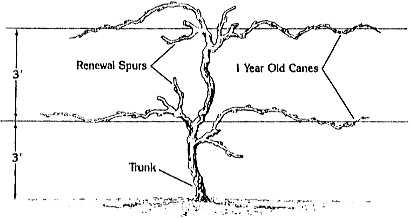
The idea is to train the vines to grow as a four- cane Kniffin system.  This system is characterised by four canes, two on each side of the trunk, trained onto two trellis wires. In addition, four very short canes (termed renewal spurs) are also retained. The renewal spurs contain one or two buds and are very important in the training system. The buds on the renewal spurs provide shoots and ultimately the canes for next year's crop. (original source)


A New Garden - Phronêsis


We are starting a new garden this year and continuing with our Stoicism theme we have named the area Phronêsis,  a word that was knocking around back in the days of the ancient Greeks and refers to a type of wisdom relevant to practical action.


 We started the initial topography survey where we will be building a forest garden during our upcoming Design and Build - Forest Garden Course - 25-28 April . This forest garden is dedicated to  Joost W. van der Laan who very generously donated to our Polyculture Project Crowdfunder last year.


I found this excellent example of succession at work in the new garden. The Northern border of Phronesis is dominated by Prunus spinosa - Sloe, a thorny pioneer shrub that establishes relatively quickly on grasslands and can creep in from woodland edges via underground suckers (rhizomes). Herbivores such as deer, sheep, goats, cattle etc. will browse the new spring growth but do not eat the lignified woody part of the plants. This encourages growth from the center of the plant to emerge and results over time in very dense compact shrubs . It's the same effect you find when you trim a shrub. The thorny nature of this plant results an impenetrable barrier for the livestock and excellent nursery site for tree seeds that may make there way into the scrub. Tree seeds that germinate in the pasture will quickly be eaten by herbivores but the seeds in the scrub are protected and as you can see in the photo below this self seeded apple tree is emerging healthily and tall. 


Over longer periods of time (10 - 40 years) the emerging trees grow larger, and the leafy crowns will shade out the pioneer shrubs killing them off  with the area eventually transitioning over to woodland. The Prunus spinosa - Sloe  can move away from the shade via the aformentioned suckers and will spread further into the grassland and in this way grassland will eventually revert to woodland. If you look closely you can see the small clumps of  Prunus spinosa - Sloe and Rosa canina - Dog Rose (that play the same role as Sloe)growing among the grasses below.
  

Forest Garden


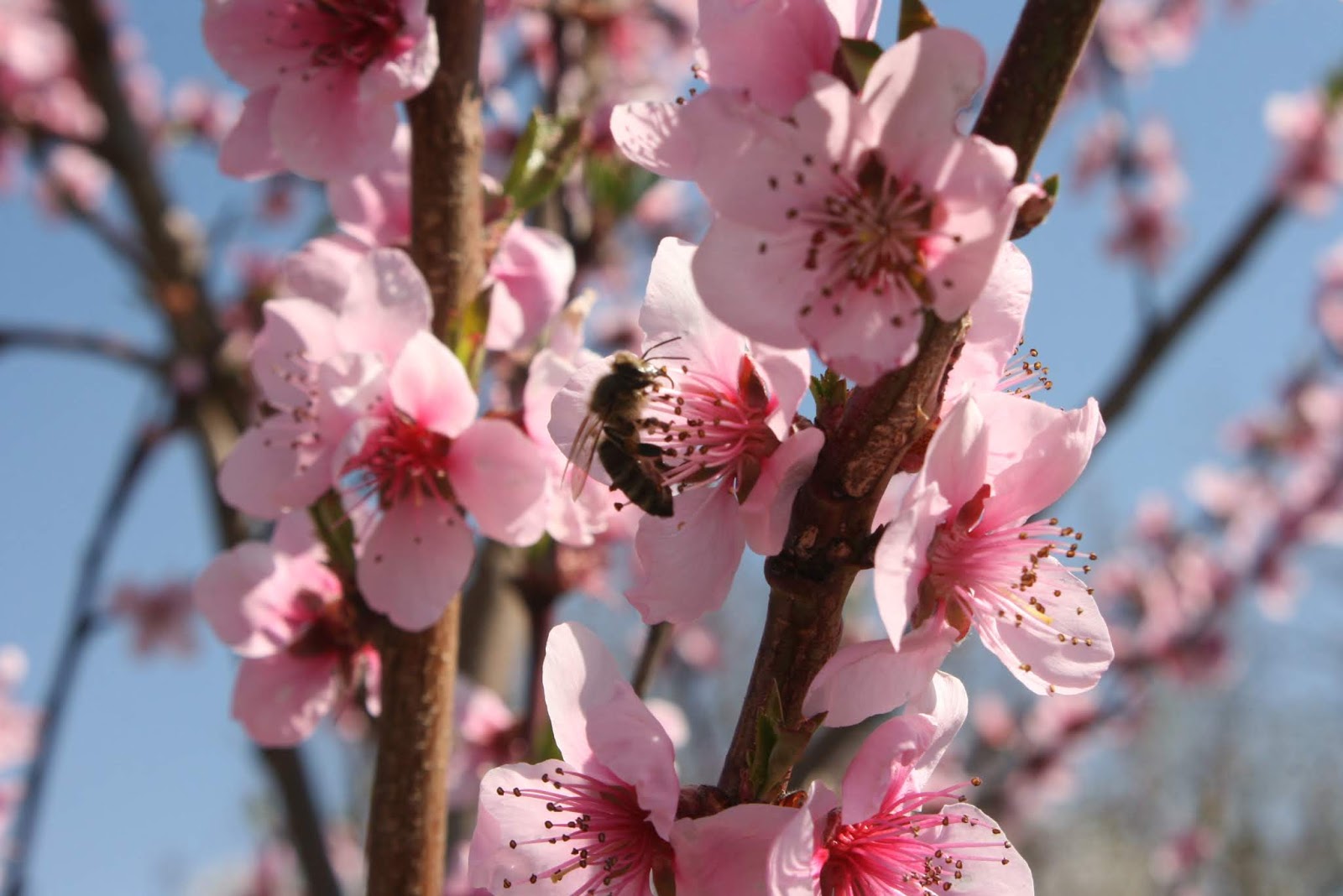
Prunus persica - Wild Peach  blossoms are very impressive this year with this 5 year old tree putting on quite a show. Looking forward to the first fruits in August. 


I'm not sure if this is guttation or dew but whatever it is it looks magical on the already beautiful Akebia quinata - Chocolate Vine.  Guttation is the exudation of drops of xylem sap on the tips or edges of leaves of some vascular plants. Dew on the other hand condenses from the atmosphere onto the plant surface.


Guttation happens at night when the soil is very moist and the roots absorb water. If there is too much water, root pressure causes the water to squeeze out of the plant and onto the tips of the leaves or the blades of the plant. As water from soil passes through the guttation process, it picks up minerals, enzymes and other chemicals and is called xylem sap. (original source). It has not properly rained here for at least 4 weeks but this plant is located right next to water tank and outside tap so perhaps it has managed to access the water? 


It's always a pleasure to witness the blossoms of  Prunus spinosa - Sloe shown here growing under Juglans regia - Persian Walnut in our perennial polyculture trial garden - Ataraxia. These plants obviously have no trouble growing under Walnuts - here is a list of other plants we have observed to be largely unaffected by negative allelopathy often associated with Walnuts. I found this interesting article regarding walnut negative allelopathy. It seems there is still much to learn.   


Regenerative Landscape Design - Online Interactive Course 


Want to learn how to design, build and manage regenerative landscapes?  Join us for our Regenerative Landscape Design - Online Interactive Course from May 1st to Sep 13th, 2023. 

We're super excited about running the course and look forward to providing you with the confidence, inspiration, and opportunity to design, build and manage regenerative landscapes, gardens, and farms that produce food and other resources for humans while enhancing biodiversity.

Regenerative Landscape Design Online Course

You can find out all about the course here and right now we have a 20% discount on the full enrollment fees. Just use the promo code
 RLD2023 in the section of the registration form to receive your discount. 

We are looking forward to providing you with this unique online learning experience - as far as we know, the very first of its kind. If you are thinking of reasons why you should do this course and whether this course is suitable for you, take a look here where we lay it all out. Looking forward to it!

--------------------------------------------------------------------------------------------------------------------------

We offer a diversity of plants and seeds for permaculture, forest gardens and regenerative landscapes including a range of fruit and nut cultivars. We Deliver all over Europe from Nov - March. - Give a happy plant a happy home :)


Our Bio-Nursery - Permaculture/Polyculture/ Regenerative Landscape Plants 

--------------------------------------------------------------------------------------------------------------------------

Support Our Project 


If you appreciate the work we are doing you can show your support in several ways.

  • Comment, like, and share our content on social media.
  • Donate directly via PayPal to balkanecologyproject@gmail.com or via FTX Pay


--------------------------------------------------------------------------------------------------------------------------


Design and Create Webinars - Forest Gardens, Urban Gardens, Permaculture, Regenerative Farming  


We're hosting a range of online learning sessions including how to create habitat to enhance biodiversity, how to design and build a forest garden, polyculture design software tutorials, regenerative farm, and landscape design, urban gardening and much more. If you would like to be notified when our next sessions are coming up please add your email below and hit subscribe and we'll be in touch.


You can also register for our online training, services, and products directly here.

--------------------------------------------------------------------------------------------------------------------------


Wednesday, 3 April 2019

Asparagus, Slowworms, Duck Havoc and an upcoming Spring Open Day

Here's what we've been up to in the gardens last week. 


But first just to let you know we've revamped our Online Store where you can find Forest Garden/ Permaculture Plants, Seeds, Cuttings, Bulbs, Rhizomes and Polyculture Multi-packs along with digital goods and services such as Online Courses, Webinars, eBooks, and Online Consultancy and finally we've added a Bulk Fruit and Nut Tree order form for Farms, Orchards, Nurseries, and Large Regenerative Landscape Projects. If there is anything in the store you would like to see but is not there, please let us know. We hope you enjoy the store and find something you like :) It's your purchases that keep our Project going. Thank you. Enter Our Store Here

Plants, Seeds, eBooks, Consultancy, Bulk Fruit and Nut Tree Orders for Permaculture, Polyculture, Forest Gardens and Regenerative Landscapes.

Market Garden


After a three year wait the Asparagus officinalis - Asparagus spears from our perennial vegetable polyculture bed have arrived. Such a fine vegetable to start the season with. The bed also includes Allium tuberosum  - Garlic Chives  that are also delicious in early spring and we should have some Fragaria x ananassa - Strawberry next month that we grow as ground cover among the Asparagus.


Asparagus officinalis - Asparagus
If you are interested how we made the asparagus bed you can find more info in our previous blog here 

Also from the Asparagaceae family (subfamily Scilloideae) are the non edible but deliciously aromatic Hyacinths. These plants are native to the eastern Mediterranean (from the south Turkey through to northern part of Palestine) and seem to handle our harsh winters here, emerging with striking inflorescence's in early spring. They are pollinated by bees but I don't notice too much insect activity around the plants.  If you have around 6,000 kg of the flowers (as you would) you can press around 1 kg of essential oil that is used in perfumery. It's also possible to obtain a blue dye from the flowers according to Ken Fern.


Forest Garden


The cherry tree blossoms are out in force, vying for the attention of the bees and other pollinators that fill the air with an invigorating buzz this time of year. The rapid wing beats of bees create vibrations in the air that our human ears detect as buzzing. It was always seem louder in the spring perhaps because there are far fewer leaves to absorb the sound waves. 


Chaenomeles speciosa - Japanese Quince is only just started to flower this year. Normally we see the flowers by the 1st week of March and sometimes in the last week of Feb. Honey bees love this plant.


Garden Wildlife 


Sophie loves cats  - I’m like, meh, are the nose rubs of one feline mammal worth the lives of countless slow worms, lizards and birds that serve to protect the lives of hundreds if not thousands of baby plants? The utilitarian in me thinks no, but I still can’t resist those nose rubs. I’ve heard putting bells on is meant to help so I should really try this out. Another trouble is that we have many semi wild cats in Shipka and the word is out that our garden is gourmet hunting ground. The other day, the supreme hunter pictured below, Cynthia, dragged in a Slowworm.
  

Fortunately the slowworm was unharmed, give or take a few scratches, and soon disappeared under the mulch upon release back into the garden. Not a great start to the season for this Slowworm - Anguis fragilis , who probably just woke up from hibernation recently.


Slowworms generally start to mate around May and the females incubate the eggs internally, 'giving birth' to an average of eight young in the summer. I find few things cuter than a baby slowworm :)  
If you would like more info on Slowworms and other reptiles of Bulgaria check out Dylan's new website here.


The Bionursery 


It's been the driest spring I can recall. I don't think it has rained since I have arrived back from Istanbul 3 weeks ago. It's not a problem for the established plants as the soils are still moist from the winter rains and snow melt, but we are having to water the nursery plants and new plantings every 5 or 6 days at the moment which is very unusual for this time of year. 


I've often said on this blog that our ducks are great in the gardens and nursery and indeed these Mallard hybrid farm ducks have been great picking off slugs and snails and leaving the plants alone. However, this is the first year we have overwintered them and it now appears that they are not quite so harmless. For starters every wildlife pond in the garden (1 large pond and 3 small tyre ponds) can now be renamed wildlifeless ponds and the heavier weight of the growing birds is causing a smeared cap to form on the beds which prevents air flow to and from the soil and decreases rainfall draining into the soil. Lastly, I was wondering why the comfrey plants had not emerged this year and have since  discovered the ducks are rather partial to the emerging Symphytum x uplandicum - Comfrey shoots.     


Here is a photo of a 2nd year Elaeagnus umbellata - Autumn Olive root. These plants are nitrogen fixing and like all plants from the Elaeagnaceae partner up with a group of Actinobacteria called Frankia. You can clearly see clumps of these bacterial colonies on the plant roots. 

Elaeagnus umbellata - Autumn Olive  nitrogen fixing nodules - Frankia spp. 

 One of the benefits of plants from our bionursery is that many of the plants form excellent relationships with beneficial microbes such as the nitrogen fixing bacteria and Mycorrhizal fungi. Standard nurseries rely heavily on synthesised pesticides, herbicides, fungicides and fertilisers, all of which will destroy these beneficial microbes.   You can find more info on nitrogen fixing plants in our previous blog here. 


Regenerative Landscape Design - Online Interactive Course 


Want to learn how to design, build and manage regenerative landscapes?  Join us for our Regenerative Landscape Design - Online Interactive Course from May 1st to Sep 13th, 2023. 

We're super excited about running the course and look forward to providing you with the confidence, inspiration, and opportunity to design, build and manage regenerative landscapes, gardens, and farms that produce food and other resources for humans while enhancing biodiversity.

Regenerative Landscape Design Online Course

You can find out all about the course here and right now we have a 20% discount on the full enrollment fees. Just use the promo code
 RLD2023 in the section of the registration form to receive your discount. 

We are looking forward to providing you with this unique online learning experience - as far as we know, the very first of its kind. If you are thinking of reasons why you should do this course and whether this course is suitable for you, take a look here where we lay it all out. Looking forward to it!

--------------------------------------------------------------------------------------------------------------------------

We offer a diversity of plants and seeds for permaculture, forest gardens and regenerative landscapes including a range of fruit and nut cultivars. We Deliver all over Europe from Nov - March. - Give a happy plant a happy home :)


Our Bio-Nursery - Permaculture/Polyculture/ Regenerative Landscape Plants 

--------------------------------------------------------------------------------------------------------------------------

Support Our Project 


If you appreciate the work we are doing you can show your support in several ways.

  • Comment, like, and share our content on social media.
  • Donate directly via PayPal to balkanecologyproject@gmail.com or via FTX Pay


--------------------------------------------------------------------------------------------------------------------------

 Design and Create Webinars - Forest Gardens, Urban Gardens, Permaculture, Regenerative Farming   


We're hosting a range of online learning sessions including how to create habitat to enhance biodiversity, how to design and build a forest garden, polyculture design software tutorials, regenerative farm, and landscape design, urban gardening and much more. If you would like to be notified when our next sessions are coming up please add your email below and hit subscribe and we'll be in touch.


You can also register for our online training, services, and products directly here.

--------------------------------------------------------------------------------------------------------------------------