Monday, 25 March 2019

Spring in the Gardens, Fruit Trees in Blossom and Ground Covers

Just one week to go before the arrival of our 2019 Polyculture Study team and we're getting ready and looking forward to another productive year in the gardens. 

I'll be posting updates each week here on what we've been up to and Archie will be managing our Instagram account uploading short videos of our activity every few days so if you would like to see what's happening there your can join the page here.  Meantime we'll kick off the season here with some observations from the early spring .   
     

But first just to let you know we've revamped our Online Store where you can find Forest Garden/ Permaculture Plants, Seeds, Cuttings, Bulbs, Rhizomes and Polyculture Multi-packs along with digital goods and services such as Online Courses, Webinars, eBooks, and Online Consultancy and finally we've added a Bulk Fruit and Nut Tree order form for Farms, Orchards, Nurseries, and Large Regenerative Landscape Projects. If there is anything in the store you would like to see but is not there, please let us know. We hope you enjoy the store and find something you like :) It's your purchases that keep our Project going. Thank you. Enter Our Store Here

Plants, Seeds, eBooks, Consultancy, Bulk Fruit and Nut Tree Orders for Permaculture, Polyculture, Forest Gardens and Regenerative Landscapes.

Forest Garden 


Our Corylus avellana - Hazelnut  plants have been flowering for the last 5 weeks and with the unusually warm and dry spring I expect a decent yield from the 4 year old plants. In the photo below you can see the fully open male catkin empty of pollen and the inconspicuous spider like female flower that is red when fresh but now withering.  For a shed load more info on Hazels check out our previous blog The Amazing Hazel - The Essential Guide to Everything you need to know about Hazels

Corylus avellana - Hazelnut Male and female flowers 

Prunus cerasifera - Cherry Plu
m
 are ridiculously full with blossoms this year. This is a 7 year old plant, grown from seed from local wild plants, that I have been trimming back from a pathway the last few years . The result is this wall of blossom. These plants are great for wildlife hedges providing abundant pollen and nectar resources, dense growth suitable for nesting birds such as tits and tasty plums from late June - Late September, depending on the plant.            


Prunus armeniaca - Apricot  blossoming, so looking forward to these fruits in Early Summer . The fruits from this plant should ripen around the second week of June. 


Corydalis bulbosa - Spring Fumewort  is one the first plants to emerge from the winter around here and one of my favourite spring ephemerals. The hedgerows and woodlands are littered with these bulbs that are general isolated plants but sometimes they form clumps of 5 or 6 plants as pictured below. 


After a few warm days here Vinca minor - Lesser Periwinkle  did not waste any time getting their flowers out much to the appreciation of the bees and other pollinating insects. This plant makes an excellent ground cover and if planted out approx. 30 cm between plants can create a thorough cover within 2 seasons. 


Tulipa sp. - Tulip find their way through the cover and as you can see in the below photo a Tanacetum vulgare - Tansy   that has just starting it's spring growth easily holds its own among the cover.  Vinca minor - Lesser Periwinkle is certainly one of the most effective ground cover plants and has the added advantage of being evergreen.   


Forsythia europaea, a plant from the olive family Oleaceae, are native here in the Balkans. We have a Forsythia in the garden that I purchased from a nursery here  about 8 years ago and it grows well and flowers profusely each year. It surprises me how I never notice bees or other pollinators attracted to the plant but it could be that the nursery plant I bought was the popular garden cultivar Forsythia x intermedia . I'll try and take a look at some the native wild plants that are often growing by the high way road sides to see if they have any pollinator action. I did find this ladybird on one of the branches.     


Rubus idaeus cv. - Raspberry emerging. If you leave some of last years stems uncut they will provide the first fruits in June. The new growth coming from the base of the plant will fruit in late September.      


 Zanthoxylum piperitum - Japanese Pepper Tree a native to  E. Asia - N. China, Japan, Korea. has very unusual bark with large spines (thorns) developing as the plant matures. The branches and leaves also have these spines albiet smaller which leads me to believe it is probably vulnerable (or was at some point) to some mammalian herbivore in its native range. The leaves and fruits are very strong tasting making an excellent spice so whatever may want to eat it must have a pretty tough palate.    


Market Garden 


Sophie got the seedlings going this winter , sowing 6 cultivars of tomatoes (see below) and basil for our Zeno polyculture trial.

T1 Solanum lycopersicum Tigeralla
T2 Solanum lycopersicum Ukranian purple
T3 Solanum lycopersicum Chocolate pear
T4 Solanum lycopersicum Alicante
T5 Solanum lycopersicum Yellow pear
T6 Solanum lycopersicum Rozova magia


Tomato seedlings started indoors for planting out in Late April 


The rest of the plants for this polyculture will be sown in the coming weeks in trays or directly in the ground. you can find out more about this Annual Vegetable and Herb polyculture here.

Zeno an Annual Vegetable and Herb Polyculture 

Sweet Genovese Basil seedlings started indoors for planting out in Late April 


For those of you that follow the blog you are probably aware that I am somewhat fond of the marvel that is Symphytum x uplandicum - Comfrey 'Bocking 14'


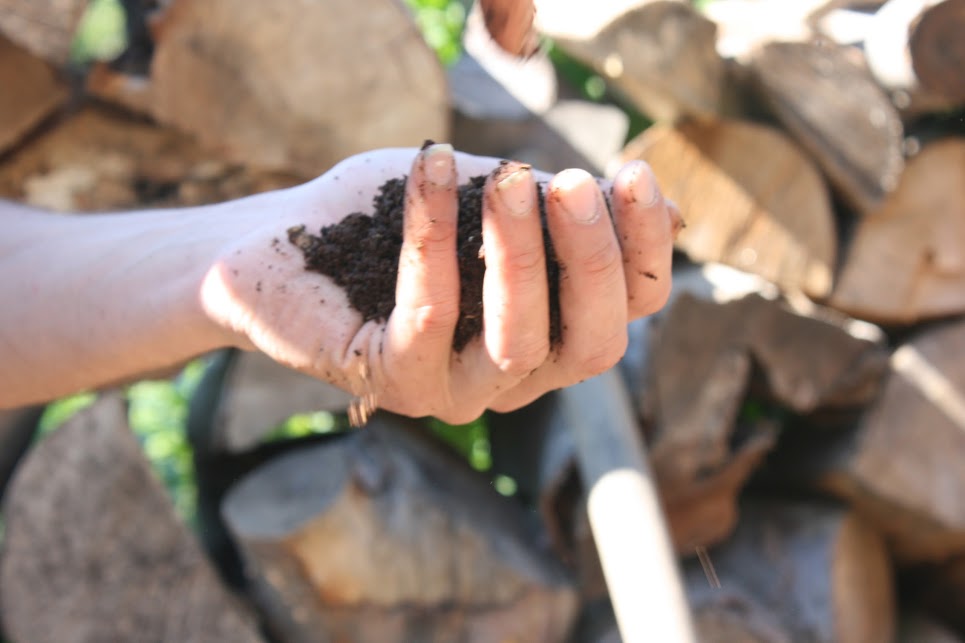
This week whilst digging up a large order of cuttings for The Forest Farmers, (a start up Regenerative Agroforesty design project in the Netherlands) I found yet another reason to show this plant some love. As the plants mature around the 4th or 5th year the crown center begins to rot and this decomposing material seems to be very attractive to the red worm Eisenia fetida ,our native composting worms. This may be one of the reasons we are observing increased soil fertility around our comfrey plants i.e the castings from these worms are highly fertile.

Eisenia fetida congregating around the decomposing heart of a 4 year old Comfrey 'Bocking 14'  

We have Comfrey 'Bocking 14' root cuttings from our online store here

Video clips from the Gardens 


Archie and his friend Mitko will be making short videos of what we're up to in the gardens this year and posting them on our Instagram Account.  Here are the first two videos. 

Grape Pruning and Propagation


Sowing a Patch of Buckwheat


If you enjoyed this post please leave us a comment and a like and even better share it with your friends on social media. The more our articles are shared the more likely they are to appear in search engines and the further we can reach people with our message and grow our project. Thank you.


Regenerative Landscape Design - Online Interactive Course 


Want to learn how to design, build and manage regenerative landscapes?  Join us for our Regenerative Landscape Design - Online Interactive Course from May 1st to Sep 13th, 2023. 

We're super excited about running the course and look forward to providing you with the confidence, inspiration, and opportunity to design, build and manage regenerative landscapes, gardens, and farms that produce food and other resources for humans while enhancing biodiversity.

Regenerative Landscape Design Online Course

You can find out all about the course here and right now we have a 20% discount on the full enrollment fees. Just use the promo code
 RLD2023 in the section of the registration form to receive your discount. 

We are looking forward to providing you with this unique online learning experience - as far as we know, the very first of its kind. If you are thinking of reasons why you should do this course and whether this course is suitable for you, take a look here where we lay it all out. Looking forward to it!


--------------------------------------------------------------------------------------------------------------------------

We offer a diversity of plants and seeds for permaculture, forest gardens and regenerative landscapes including a range of fruit and nut cultivars. We Deliver all over Europe from Nov - March. - Give a happy plant a happy home :)


Our Bio-Nursery - Permaculture/Polyculture/ Regenerative Landscape Plants 

--------------------------------------------------------------------------------------------------------------------------

Support Our Project 


If you appreciate the work we are doing you can show your support in several ways.

  • Comment, like, and share our content on social media.
  • Donate directly via PayPal to balkanecologyproject@gmail.com or via FTX Pay


--------------------------------------------------------------------------------------------------------------------------

Design and Create Webinars - Forest Gardens, Urban Gardens, Permaculture, Regenerative Farming   


We're hosting a range of online learning sessions including how to create habitat to enhance biodiversity, how to design and build a forest garden, polyculture design software tutorials, regenerative farm, and landscape design, urban gardening and much more. If you would like to be notified when our next sessions are coming up please add your email below and hit subscribe and we'll be in touch.


You can also register for our online training, services, and products directly here.

--------------------------------------------------------------------------------------------------------------------------

Monday, 11 February 2019

A unique learning opportunity focused on how we can provide nutritious affordable food while enhancing biodiversity.

We are on a mission to discover methods of landscape management that can provide nutritious affordable food while enhancing biodiversity. We are delighted to be offering a unique opportunity to take part in our study, would you like to join us ?

What are we doing ?


We are undertaking a multi year study of market gardening growing herbs, vegetables and perennial fruit and nut polycultures. The study aims to compare our polyculture plots with conventional organic plots, record levels of biodiversity in the gardens and look at set up and running costs (in terms of finances and time) and outputs in terms of produce and income.

Diversity of high quality biologically produced food from our polyculture gardens 

The approach we take to market gardening goes way beyond "organic". We design biological systems that rely on the native ecology to function as opposed to external manufactured inputs, and as a result our gardens service not only our needs but the needs of other organisms too.


Permaculture/Polyculture Market Garden @Balkan Ecology Project

What will you be doing ?


You'll be working closely as a team producing food from the market garden for yourself, local markets, and a food co-operative and will be recording all aspects of the process including how long it takes to develop, maintain and manage the associated costs, the fertility requirements, the returns in produce weight and income derived from the sale of the produce.


Our Polyculture Market Garden - photo by Huma

We will also be working on a new experimental garden growing perennial polycultures providing fruits, nuts, vegetables, biomass, timber and wildlife habitat.  You can find out more about our perennial polyculture trail gardens here 

Perennial Polycuture Trial Garden


Click here for the Garden location (labelled as  East Side Trial Garden on our Project map)

We are planning to record all aspects of the project including observed levels of invertebrate diversity  and soil analysis. We’ll be looking closely at inputs i.e set up/running costs, fertility/water requirements and time, and outputs i.e produce, income, soil fertility and invertebrate diversity.

The aim of the trials is to test the ecological and economical viability of growing these polycultures in market gardens and farms in order to meet the following needs/wants:
  • production of high quality, high value food 
  • cash crops from secondary/ tertiary polyculture partner species
  • improvement of soil fertility
  • provision of biomass for use as mulch
  • timber supply for use as vegetable supports and larger round wood material for farm infrastructure
  • enhanced levels of biodiversity


Some of the resident wildlife from our permaculture market garden. 


Finally, this year we'll be starting the development of a new Bee Garden - Eudaimonia


Why should you take part ?


​This is an excellent opportunity if you are considering starting a garden enjoy landscape design and/or are interested in ways to provide affordable healthy food whilst increasing biodiversity.

As a participant of this study -

  • You will gain valuable insight into what it takes to actually run a market garden. As well as the practical skills you will develop, we'll dedicate time each week to covering essential theory including site design and implementation, plant propagation, polyculture management, basic botany, record keeping, harvesting, irrigation, marketing and advertising, and budgeting/financial planning. 
  • Enrollment to the 6 month program entitles you to participate in courses and training events that take place during the program. 
  • You will be contributing to an area of research where little information exists i.e the productivity of polycultures and associated biodiversity dynamics. 
  • This study will be published online and freely available to all for future reference and you will be credited accordingly.
  • You will be spending time in a truly unique area of the world, working as part of a dynamic team of fellow enthusiasts in an inspiring environment.

Previous participants in the gardens  


Where will you be?


The project is based in the town of Shipka, Bulgaria on the foothills of the Central Balkan mountain range in the Rose Valley. It's an area of high biodiversity, beautiful countryside and historical sites of global, cultural and scientific significance. The project site is located on an abandoned piece of agricultural land on the western outskirts of the town that we call the Paulownia Garden. See Map for Paulownia Garden Location.


Shipka Town - home to Balkan Ecology Project 


You'll also be learning from our existing garden, a 10 year old residential property with a highly productive and well established forest garden composed of over 400 species of plants. Our central garden is a good example of small scale intensive ecological design and includes examples of rainwater harvesting, wildlife ponds, multiple composting facilities and hosts a small plant nursery. We practice various methods of biological vegetable production including guild planting and crop rotation, and have reared pigs, chickens and rabbits from this property.


The Home Garden

How to take part?


The study will run from April 1st - September 30th. Ideally you will be able to commit to the project for the full duration of time. We are also willing to accept applications for shorter periods of time if you feel passionate about joining the project but cannot dedicate 6 months, 4 week being the minimum.

The contribution for joining the study for the full 6 month period ( April 1st - September 30th) is €650. This includes rent and bills for the whole period and admission to all courses and events held during those dates.

If you would like to participate for less than the full 6 months the fee is €150 per month, (price includes rent and bills.)

Once we have received your registration we will contact you and arrange a Skype meeting to talk through the process and answer any questions that may arise.

Following this, if you decide you would like to take part, the fee for the duration of your stay should be paid in full to secure your place. Payment can be made via PayPal (processing fees apply ) or bank transfer in £,€ or BGN.

Accommodation


Our self catering volunteer house is basic but comfortable in a beautiful location at the edge of Shipka and around 15 - 20 minutes walk away from the project site. The house has Wi-Fi internet, a shared kitchen and bathrooms and a garden. ​

The Volunteer House -  a view from the east 

Fruits and vegetables produced from the gardens are available to you from June onwards, and quality products such as eggs, milk, cheese, honey and meat can be purchased from local producers. The cost of living is relatively low here and estimates of living costs based on the experience of previous participants is between €90 - €120 per month.

There is plenty to do around Shipka and our location is perfect for exploring. The wild coasts of the Black and Adriatic Sea are just a few hours away, extensive trails deep into the Balkan mountains start from your doorstep. Istanbul, Bucharest and Thessaloniki are a bus ride away and there are great day trips includng Koprinka Lake, Kalofer waterfalls, Buzludja and Etara living Museum to name but a few.

Why are we undertaking this study ?


Industrial agricultural practices often result in destruction of habitat for many organisms. We believe this is unnecessary, and want to provide healthier models of agriculture that can provide nutritious affordable food while at the same time promoting biodiversity and general ecosystem health.

Industrial methods are heavily researched and funded, and there is a general belief among many farmers that this is the only practical way of operating. Following 12 years of cultivating polyculture gardens we are seeing that small scale biologically cultivated polyculture gardens are a realistic and practical way of providing food for humans whilst preserving biodiversity in the environment. Furthermore we believe this type of agriculture can help create thriving local economies that strengthen community and enhance the amenity value of an area.

Little data exists showing the productive capacity of polyculture systems and the economic viability of them. There is a big need to fill this gap and provide solid data and concise coherent models that can be replicated easily and provide real solutions to the environmental damage caused by industrial agriculture. This project intends to go some of the way in filling this gap.

Registration is now open. Register here.

Here's what previous year's participants said!


Last years polyculture study team 


"Taking part in the Polyculture Study was a life-changing and inspiring time for me. I learned loads about permaculture, about Bulgaria and to reconnect with the simple things in life. On top of that Paul, Sophie and their kids are awesome people! I'd recommend this to anyone wanting to learn more about permaculture, experiencing rural life or just thinking of a change of career and lifestyle!" - Ute Villavicencio

"I took part in the 2016 Polyculture Market Garden Study with the Balkan Ecology Project. I started without much knowledge of gardening at all, but the hands-on work at the study sites, alongside the weekly theory lessons, helped me build an understanding of permaculture principles. By putting these into practice, I learnt how to create a productive polyculture market garden, and how to apply sustainable, eco-friendly design to a plot of land.
I also had time to complete an online Introduction to Permaculture course, travel to other Bulgarian towns on weekends, walk in the mountains and work in the home garden. Paul, Sophie and the boys are wonderfully warm, supportive and knowledgeable hosts, the study team were fantastic and Shipka is a very special place. I highly recommend getting involved! " - Marika Wanklyn

" Being a part of the Polyculture Study was a very special period of my life. I realized how inspiring it is to be in touch with soil and plants, and creatures inhabiting the garden I worked in, and also to be in good touch with the people I worked with. I am happy to have had this opportunity to support the Study and the wonderful family behind it, and to be supported by them in return." Anna Boncheva

    Upcoming Forest Garden Courses 


    If you would like to create a forest garden and gain some practical hands-on experience come and join us for our Design and Build a Forest Garden Course. We'll be covering site surveying, landscape design software, installing access, beds, irrigation channels, planting tree, shrub, herb and ground layers, and wildlife ponds. All in 3 days! And plenty of follow up material to take away with you to digest slowly.


    ----------------------------------------------------------------------------------------------------------------------

    Regenerative Landscape Design - Online Interactive Course 


    Want to learn how to design, build and manage regenerative landscapes?  Join us for our Regenerative Landscape Design - Online Interactive Course from May 1st to Sep 13th, 2023. 

    We're super excited about running the course and look forward to providing you with the confidence, inspiration, and opportunity to design, build and manage regenerative landscapes, gardens, and farms that produce food and other resources for humans while enhancing biodiversity.

    Regenerative Landscape Design Online Course

    You can find out all about the course here and right now we have a 20% discount on the full enrollment fees. Just use the promo code
     RLD2023 in the section of the registration form to receive your discount. 

    We are looking forward to providing you with this unique online learning experience - as far as we know, the very first of its kind. If you are thinking of reasons why you should do this course and whether this course is suitable for you, take a look here where we lay it all out. Looking forward to it!


    --------------------------------------------------------------------------------------------------------------------------

    We offer a diversity of plants and seeds for permaculture, forest gardens and regenerative landscapes including a range of fruit and nut cultivars. We Deliver all over Europe from Nov - March. - Give a happy plant a happy home :)


    Our Bio-Nursery - Permaculture/Polyculture/ Regenerative Landscape Plants 

    --------------------------------------------------------------------------------------------------------------------------

    Support Our Project 


    If you appreciate the work we are doing you can show your support in several ways.

    • Comment, like, and share our content on social media.
    • Donate directly via PayPal to balkanecologyproject@gmail.com or via FTX Pay


    --------------------------------------------------------------------------------------------------------------------------

    Design and Create Webinars - Forest Gardens, Urban Gardens, Permaculture, Regenerative Farming   


    We're hosting a range of online learning sessions including how to create habitat to enhance biodiversity, how to design and build a forest garden, polyculture design software tutorials, regenerative farm, and landscape design, urban gardening and much more. If you would like to be notified when our next sessions are coming up please add your email below and hit subscribe and we'll be in touch.


    You can also register for our online training, services, and products directly here.

    --------------------------------------------------------------------------------------------------------------------------


    Friday, 1 February 2019

    How to Design and Build A Forest Garden - Part 1. Surveying

    Forest Gardens are an excellent way to produce food and other resources for humans while enhancing biodiversity by providing a range of habitat for wildlife within the design. They are very enjoyable to design, build and interact with. Creating a forest garden is an intellectual pursuit as well as a physical one. It’s like a living, 3D amorphous puzzle that you can eat : )

    Autumn of 2018 we tried out a new course format, the "Design 'n Build", an intensive practical course where we go through the whole design process of a forest garden and complete the build of a project within 3 days. We had a great group join us for the course and managed to complete the design and build of a 100 m2 forest garden consisting of around 120 plants representing 22 species (not including the local plants).


    During this post we'll cover how we designed and built this forest garden, starting with the design for the garden illustrating the garden when initially planted and when mature and a look at the specifications of the site.


    The Site Specs   


    ​Climate: Temperate
    Köppen Climate Classification - Dfc borderline Cfb
    USDA Hardiness Zone: 5b - 7a
    Latitude: 42°
    Elevation: 574 m
    Average Annual Rainfall: 588.5 mm


    Ataraxia - Forest Garden -  before and after


    A great starting point for any land-based design is surveying the plot and surrounding area. On the first day of the course following a brief introduction we got straight to work with the climate surveys. This work that can be largely achieved with a PC and the internet. 


    Climate Survey


    We start with the climate survey that helps to define the boundaries of our options. The kind of information we are looking for here is as follows:

    Mean temperatures and the average amount of rain your site receives each year and in what months that rain is received. It's very useful to have the extreme records for this info too, i.e, what is the most amount of rainfall recorded in any one event in any one month and what were the hottest and coldest days recorded.     


    How much light your site receives throughout the year and how that light is distributed on the ground (which objects create shade)


    If relevant, how many days of snow cover will you receive  


    Temperature patterns of your site. The lowest and highest recorded temperatures are very important to know, as are the dates of your first and last frosts


    The wind patterns of your site, from which direction does the wind blow and how intense is that wind?  

    You can find the above information with the charts at www.meteoblue.com


    Botanical Survey


    We then moved onto the site to take a look at the botany, taking note of the vegetation, specifically the layers that are already growing on the site. Obviously we did not have time to record all of the plants (best achieved by surveying in each season)  but we have been making these records for the last few years. We looked at a few indicator species and methods to categorise and record plants. 


    Making a botanical survey is a great way to really get to know your site and of course, the resident  plants.

    Some of the amazing polyculture that already exists on the site (photos from spring- summer)

    Here's a list of some of the existing plant species from this site.


    TREESHERBS
    Crataegus sp.
    Hawthorn
    Hypericum perforatum
    Perfoliate St John's Wort
    Prunus cerasifera
    Myrobalan Plum
    Verbascum thapsus
    Great Mullein
    Cornus Mas
    Cornelian Cherry
    Veronica sp.
    Speedwell
    SHRUBSCruciata laevipes
    Crosswort
    Rosa Canina
    Dog Rose
    Galium aparine
    Cleavers
    Rubus fruticosus var.
    Blackberry
    Bellis perennis
    Daisy
    Prunus spinosa
    Sloe
    Malva alcea
    Malva
    HERBSVicia lutea
    Yellow Vetch
    Mentha longifolia
    Horsemint
    Medicago arabica
    Spotted Meddick
    Cichorium intybus
    Chicory
    GROUND COVER
    Origanum vulgare
    Oregano
    Lamium maculatum
    Spotted Dead Nettle
    Ranunculus spp.
    Buttercup
    Clematis vitalba
    Travellers Joy
    Aristolochia clematitis
    Birthwort
    Hedera helix
    Ivy
    Vicia hirsuta
    Hairy Tare
    BULB
    Plantago major
    Greater Plantain
    Ornithogalum sp.
    Ornithogalum
    Plantago media
    Hoary Plantain
    Muscari neglectum
    Grape-hyacinth
    Vicia cracca
    Tufted Vetch
    Corydalis bulbosa
    Corydalis
    Orlaya grandiflora
    White Lace
    Scilla bifolia
    Alpine Squill


    In all of the perennial polycultures I design, my intention is to retain all of the existing species and to add more edible/productive plants along with fertility/support plants to assist them. More often than not many of the plants already growing on your site will be edible, medicinal, attractive to wildlife and fascinating organisms that are well worth getting to know. 

    Regenerative Landscape Design - Online Interactive Course

    Want to learn how to design, build and manage regenerative landscapes? Join us on our Regenerative Landscape Design - Online Interactive Course.

    The course includes 20 lessons, with 20 hours of one-to-one mentoring/consultancy, drawn from over 20 years of experience designing, implementing and managing polyculture gardens, farms, food forests and regenerative landscapes across a variety of climate zones.

    We look forward to providing you with the confidence, inspiration, and opportunity to design, build and manage landscapes that produce food and other resources for humans while enhancing biodiversity.

    You can access all of the course material without the one-to-one tutoring by becoming a paid annual subscriber to our Substack, which grants you access to the Bloom Room for just 70 USD per year. Subscribe below to join now.

    I look forward to having you join us!

    Soil Survey


    Next we made a simple but effective soil survey to gauge the quality of the soil we are working with.


    The soil test covers the below:

    1.GROUND COVER - What is covering the surface of the soil
    2.PENETROMETER - How easy is it to penetrate the soil
    3.INFILTRATION - How quickly the soil drains water
    4. DIVERSITY OF MACROLIFE - Quantity of visible soil organisms present on the surface
    5. ROOT DEVELOPMENT - How the plant roots are distributed throughout the soil profile
    6. SOIL STRUCTURE - How the solid parts of soil and the pore space between them are arranged
    7. AGGREGATE STABILITY - How stable is the structural arrangement
    8. EARTHWORMS - How many
    9. LAB ANALYSIS - pH - the mineral content of your soil


    Katrin, Andreas and Frances Making the soil test.

    Apart from Lab Analysis, all of the tests can be carried out with materials you will likely have around you. This soil test, when repeated each year, is a great way to track the progress of your soil overtime and to see how your methods are increasing or decreasing the health of your soil. The tests were developed by Northern Rivers and you can find full instructions and more info here.

    A quick intermission just to let you know about our Online Store where you can find Forest Garden/ Permaculture Plants, Seeds, Cuttings, Bulbs, Rhizomes and Polyculture Multi-packs along with digital goods and services such as Online Courses, Webinars, eBooks, and Online Consultancy. It's your purchases that keep our Project going. Enter Our Store Here

    Plants, Seeds, eBooks, Consultancy, Bulk Fruit and Nut Tree Orders for Permaculture, Polyculture, Forest Gardens and Regenerative Landscapes.

    Cadastral and Topography Survey 


    After lunch we were back on site for the cadastral survey, to  mark the perimeter of the design area and to make a topography survey in order to gain an understanding of the shape of the ground i.e where it slopes, high points and low points etc.

    Cadastral - In this case the boundary for the garden was defined by existing features of the site, i.e, a hedgerow to the west, a main access path to the east, the property boundary to the south and an overflow swale for the main pond to the north. When marking the boundaries of the design we made sure to include a 1 m wide pathway around the entire area.


    The corners of the plot were staked and we measured the distance between each corner with a measuring wheel taking note of each distance between each point in order to recreate the design on software later. You can also do this with a very accurate GPS (RTK based) and an orthophoto (an aerial photograph or image geometrically corrected such that the scale is uniform and corresponds to the GPS data).

    A standard smart phone GPS and google earth do not provide anything of practical use at this scale. For a multi hectare plot they are adequate to gain a general impression.


    Topography Survey - Next we embarked upon the topography survey

    Using a transit level we established the contour lines on the site and measured elevation distance from the highest to the lowest point of the site. 

    We found we have a mild slope from the North to the South and towards the East. Given that we have an irrigation channel to the west of the garden this meant that we could arrange irrigation channels and  planting patterns to take advantage of gravity to irrigate all of the plants on the site.

    The irrigation channel design we choose determined the layout of our access which in turn provided  us with a number of subdivisions within the plot.


    That's all for this post, and in How to Design and Build A Forest Garden - Part 2 - Creating, we will look at how we selected plants for the design, the rationale behind our plant placement , how we prepared the site for the work to begin,  how we established the irrigation channels, pathways and planting zones for the plants, our planting out techniques and how to manage the garden.

    If you enjoyed this post please leave us a comment and a like and even better share it with your friends on social media. The more our articles are shared the more likely they are to appear in search engines and the further we can reach people with our message and grow our project.

    Support Our Project

    If you appreciate the work we are doing you can show your support in several ways.


    ---------------------------------------------------------------------------------------------------------------

    We offer a diversity of plants and seeds for permaculture, forest gardens and regenerative landscapes including a range of fruit and nut cultivars. We Deliver all over Europe from Nov - March. - Give a happy plant a happy home :)


    Our Bio-Nursery - Permaculture/Polyculture/ Regenerative Landscape Plants