Sunday, 27 September 2015

Plants That Can be Grown Around Walnuts and Hickories - Juglone Tolerant Plants

Plants Tolerant to Juglone


Walnuts and hickories produce the chemical juglone, which is exuded from all parts of the plant. This chemical can inhibit the growth rate of nearby plants, a phenomenon known as negative alleopathy.

 
The following lists of plants tolerant to juglone were compiled from published sources. They are based on observation under various settings, but few plants have been experimentally tested for sensitivity to juglone. The plants highlighted in green are species I have personally observed growing seemingly unhindered in and around the under story of Juglans regia.

Walnuts from our Gardens  
Welcome to our Online Store where you can find Forest Garden/ Permaculture plants, seeds, bulbs and Polyculture multi-packs along with digital goods and services such as Online Courses, Webinars, eBooks, and Online Consultancy.  We hope you enjoy the store and find something you like :) It's your purchases that keep our Project going. Yuu can also find our full list of trees. shrubs and herbs for forest gardens on our website here 


Many factors affect sensitivity, including level of contact, health of the plant, soil environment, and the overall site conditions. Aside from juglone, a mature walnut will cast a very heavy shade and young sun demanding plants will not survive in these conditions. The lists provided here are strictly guides and cannot be considered complete or definitive.

20 yr old Walnut in our Garden  with Sambucus nigra, Aronia melanocarpa and Pyrus cv. doing very well 


If you have experience of plants growing well under and around a Juglone producing plant that are not on this list, please share in the comments section below.

Regenerative Landscape Design - Online Interactive Course

Want to learn how to design, build and manage regenerative landscapes? Join us on our Regenerative Landscape Design - Online Interactive Course.

The course includes 20 lessons, with 20 hours of one-to-one mentoring/consultancy, drawn from over 20 years of experience designing, implementing and managing polyculture gardens, farms, food forests and regenerative landscapes across a variety of climate zones.
We look forward to providing you with the confidence, inspiration, and opportunity to design, build and manage landscapes that produce food and other resources for humans while enhancing biodiversity.

You can access all of the course material without the one-to-one tutoring by becoming a paid annual subscriber to our Substack, which grants you access to the Bloom Room for just 70 USD per year. Subscribe below to join now.

I look forward to having you join us! 

View our previous post for The Essential Guide to Everything you Need to Know about Walnuts!.


Bulgarian Walnut Cultivars - Hardy and Resistant to Major Pest and Diseases 


Below you can find profiles of some Bulgarian cultivars that we have on offer at our Bio-nursery. These cultivars are high yielding and resistant to common walnut diseases. 

We are currently offering these cultivars at ​​ €22 per tree with a 10% discount for orders over 25 trees. Delivery to all over Europe

For other disease-resistant walnut cultivars see Agroforestry Research Trust.

Cultivar - 'Izvor 10'

  • Fruiting - The fruit forms on lateral buds and ripen around mid September. Excellent tasting oblong nuts with a thin shell. The nuts weigh around 10 g have a high fat content - 55.7%.
  • Disease Resistance - Excellent resistance to Walnut anthracnose and Walnut blight
  • Form - The tree forms a broad, relatively thin crown
  • Hardiness - A very hardy cultivar tolerating temperatures down to -25 - 30 ºС
  • Flowering Period - Late

Cultivar - 'Sheinovo'

  • Fruiting - The fruit forms on the tips and ripen around mid September. Excellent tasting nuts that are easy to remove from the thin shell. The nuts weigh around 12 -13 g and have a high fat content - 71.4% . 
  • Disease Resistance - Good resistance to Walnut anthracnose and Walnut blight 
  • Form - The tree is vigorous with a wide spread crown 
  • Hardiness - A hardy cultivar tolerating temperatures down to -24 ºС 
  • Flowering Period - Mid - Late

Cultivar - 'Dryanovo'


  • Fruiting - Fruits for on the tips of branches and ripen to very large 14 - 18 g round nuts. The fat content is 67.39%. 
  • Disease Resistance - Very resistant to anthracnose, though very susceptible to blight. 
  • Form - The tree is vigorous with dome shaped crown 
  • Hardiness - A hardy cultivar tolerating temperatures down to -24 ºС 
  • Flowering Period - Mid - Late

Support Our Project

If you appreciate the work we are doing you can show your support in several ways.


---------------------------------------------------------------------------------------------------------------

We offer a diversity of plants and seeds for permaculture, forest gardens and regenerative landscapes including a range of fruit and nut cultivars. We Deliver all over Europe from Nov - March. - Give a happy plant a happy home :)


Our Bio-Nursery - Permaculture/Polyculture/ Regenerative Landscape Plants 

Saturday, 5 September 2015

Planting out Guide

Autumn is a great time to plant out. The adequate rainfall and consequent soil moisture levels at this time of year are perfect for the newly establishing plant roots.  Although it may be cold above ground, the warmer soil temperatures make it possible for plant root growth to continue for longer and settle in before the spring growth bonanza.

 Here's a step by step guide to planting out including a few things to consider before and after planting.

But first just to let you know we've revamped our Online Store where you can find Forest Garden/ Permaculture Plants, Seeds, Cuttings, Bulbs, Rhizomes and Polyculture Multi-packs along with digital goods and services such as Online Courses, Webinars, eBooks, and Online Consultancy and finally we've added a Bulk Fruit and Nut Tree order form for Farms, Orchards, Nurseries, and Large Regenerative Landscape Projects. If there is anything in the store you would like to see but is not there, please let us know. We hope you enjoy the store and find something you like :) It's your purchases that keep our Project going. Thank you. Enter Our Store Here

Plants, Seeds, eBooks, Consultancy, Bulk Fruit and Nut Tree Orders for Permaculture, Polyculture, Forest Gardens and Regenerative Landscapes.

A few things to consider before planting 


  • The best time to plant is when the soil is moist after a rain. If the soil is very wet, treading can cause compaction so avoid working on very wet soils particularly if your soil is clay.
  • In choosing the position for your plant, bear in mind the light, fertility, water, temperature, space and community needs of the organism.
  • Consider the maximum size of the plant and how it will relate to the surroundings of the position you have chosen.
  • For plants that require cross pollination  or are dioecious you will need to consider the pollination needs and make sure you have a pollinator in the vicinity.  
  • If you are establishing bare rooted plants ensure that the roots are not exposed to direct sunlight for too long and that they do not dry out.
  • Soak your plant roots well before planting. I have had no problems leaving the bare rooted plants submerged in water for up to 12 hrs. Cover so that sunlight cannot harm the roots when in the water.    

     Planting instructions


      • Dig your hole sufficiently to allow some space around the root ball or roots ie, do not cram the plant into a small hole. Twice the diameter of your pot is adequate.  
      • When digging, separate the top soil and sub soil layers. This is best achieved by placing two boards or tarps next to your hole. Dig the top soil out and pile it on one board/tarp, now dig the subsoil out and pile it on the second board/tarp.
        • Make sure the bottom and sides of your hole are not compacted from digging. If there are any smeared surfaces, scrape them loose with a fork. This ensures easier access into the soil for the establishing roots as well as providing good drainage and air spaces.    
        • Water the empty hole well and allow time for the water to drain away. If your plant is in a container then rough up the sides of the root ball. The purpose of this is to ensure the fine roots make good contact with the soil when you infill the planting hole.
        • Due to the fast draining sandy loam I normally work with I plant a little lower than ground level to provide a dish for water to collect in. If you have poor draining soil (heavy clay)  in an area of high rainfall and/or a high water table then you should consider planting higher then ground level.
        • If your planting site has a history of intensive application of fungicides you should re-establish the Mycorrhizal community.  Mycorrhizas are symbiotic relationships between fungi and plant roots (the term means literally 'fungus root'). They are very common on crop plants as well as in wild plant communities, and in several cases they have been shown to be important or even essential for plant performance. The fungus obtains at least some of its sugars from the plant, while the plant benefits from the efficient uptake of mineral nutrients (or water) by the fungal hyphae. You can re-establish the Mycorrhizal community by simply adding half a spade full of soil from a healthy soil ecosystem nearby which should contain many of the beneficial fungal organisms. Mix the healthy soil with your pile of top soil.   
        Picture shows how the plant can draw upon a much larger pool of soil resources with the assistance of  mycorrhizal fungi 
          • Back fill the hole with the sub soil first, pack the soil in firmly around the roots or root ball and then add the top soil, again tampering the soil firmly to ensure good contact is made between soil and roots. The idea behind keeping the soil layers in order is to create minimum disturbance to the existing soil ecology. It may just look like plain earth but there are a myriad of organisms at work in there.       
          • You can remove surrounding vegetation to approx 50cm radius of the plant stem so you end up with a circle of bare earth approx 1m diameter with your plant in the centre.  If your plant is small then you can make this area smaller.       
              • Imagine which way the water would flow across the land surrounding your plant, and pile up the organic matter you have scrapped away from the surface along with any left over soil to create a barrier that will block the water from moving away from the plant. You want to keep the water around the plant where it can drain into the soil slowly and soak through to the roots below ground. It may be that on flat ground you need a barrier surrounding the plant creating a dish in which the water fills. If you have a low water table,  lots of rain in your area and poor draining clay soil then this is not advisable.   

                • Water the plant again applying more water then you think you will need and watch to see how well the water stays around the plant root zone. If you see the water escaping make some amendments to your barrier. 
                • Once the plant is watered, apply mature compost approx 2-3 cm deep covering the bare earth and place wet cardboard sheets or old clothing or cloth over the compost. If more than one piece of cardboard is needed overlap the cardboard so there are no gaps. This layer provides a barrier to prevent weed seeds in the soil from germinating and will decompose to add extra fertility to the soil. You can also use proprietary organic mulch mats -  I've heard they last a few seasons.  
                • Cover the cardboard/cloth/mulch with a further 3cm of well matured compost and then cover this with a 10cm layer of straw mulch (or other seedless mulch).   
                  • If trees are planted too deeply or too much mulch is placed around the base of the tree, the constant moisture against the bark will create a condition called collar rot. Once the protective bark has rotted away, insects, micro organisms and fungi can easily enter the tree and begin to damage the plant. Make sure that the soil and mulch layers are not in direct contact with the bark around the base of the stem (the collar).  Be sure to clear away the mulch and compost from that area so that you end up with a visible gap of at least 5 cm between stem and soil. You should check this every so often as the mulch usually makes its way back around the collar.
                  Collar Rot in a Apple Tree from - http://www.appleman.ca/korchard/treerots.htm

                    Aftercare considerations   


                      • If planted in Autumn it is likely that your new plants will not need watering until the mid spring. Keep an eye on your plant and water if you see/feel the soil below the mulch is dry. It's important to keep the plant from drying out in the first few years so plan time to monitor. Ninety percent of all problems with newly-planted trees are because the steward didn't water them.
                      • If planting a tree whip, according to some reports and contrary to popular belief, staking is not necessary.  It is claimed to be counter productive and discourages a young tree from forming strong and secure anchor roots. Large container trees will, however, need staking. 
                      • Tree barriers are recommended to prevent herbivores committing planticide and according to the manufactures have many other purported benefits ;) I have never used these so cannot comment.     
                      • Check your plant from time to time and make sure the mulch has not made its way back around the stem collar. Keep the area weed free for a few years by topping up the cardboard and if you have planted a tree with high nutrient demands apply extra compost the following autumn. 
                        • Finally, enjoy your plant!      


                        Regenerative Landscape Design - Online Interactive Course 


                        Want to learn how to design, build and manage regenerative landscapes?  Join us for our Regenerative Landscape Design - Online Interactive Course from May 1st to Sep 13th, 2023. 

                        We're super excited about running the course and look forward to providing you with the confidence, inspiration, and opportunity to design, build and manage regenerative landscapes, gardens, and farms that produce food and other resources for humans while enhancing biodiversity.

                        Regenerative Landscape Design Online Course

                        You can find out all about the course here and right now we have a 20% discount on the full enrollment fees. Just use the promo code
                         RLD2023 in the section of the registration form to receive your discount. 

                        We are looking forward to providing you with this unique online learning experience - as far as we know, the very first of its kind. If you are thinking of reasons why you should do this course and whether this course is suitable for you, take a look here where we lay it all out. Looking forward to it!


                        --------------------------------------------------------------------------------------------------------------------------

                        We offer a diversity of plants and seeds for permaculture, forest gardens and regenerative landscapes including a range of fruit and nut cultivars. We Deliver all over Europe from Nov - March. - Give a happy plant a happy home :)


                        Our Bio-Nursery - Permaculture/Polyculture/ Regenerative Landscape Plants 

                        --------------------------------------------------------------------------------------------------------------------------

                        Support Our Project 


                        If you appreciate the work we are doing you can show your support in several ways.

                        • Comment, like, and share our content on social media.
                        • Donate directly via PayPal to balkanecologyproject@gmail.com or via FTX Pay

                        Tuesday, 25 August 2015

                        Cracking up

                        This week the majority of the tomatoes from the Polyculture Market Garden Study had cracks around the tops or along the sides. We weighed out 6.100 kg of tomatoes in good condition and 16.325 kg of split tomatoes that are okay for preserving in jars, but not suitable for market. A further 2.925 kg of tomatoes were in poor condition and only fit for the pig and chickens, who did not seem to mind at all :)

                        The tomatoes in our 9 year old residential garden also suffered, although not as badly.   
                          
                        So why have our tomatoes cracked up this week? Here's some information on tomato cracking and how to deal with it in the ecological garden.

                        First, just to let you know that we've revamped our Online Store where you can find Forest Garden/ Permaculture Plants, Seeds, Cuttings, Bulbs, Rhizomes and Polyculture Multi-packs along with digital goods and services such as Online Courses, Webinars, eBooks, and Online Consultancy and finally we've added a Bulk Fruit and Nut Tree order form for Farms, Orchards, Nurseries, and Large Regenerative Landscape Projects. If there is anything in the store you would like to see but is not there, please let us know. We hope you enjoy the store and find something you like :) It's your purchases that keep our Project going. Thank you. Enter Our Store Here

                        Plants, Seeds, eBooks, Consultancy, Bulk Fruit and Nut Tree Orders for Permaculture, Polyculture, Forest Gardens and Regenerative Landscapes.

                        What is cracking? 

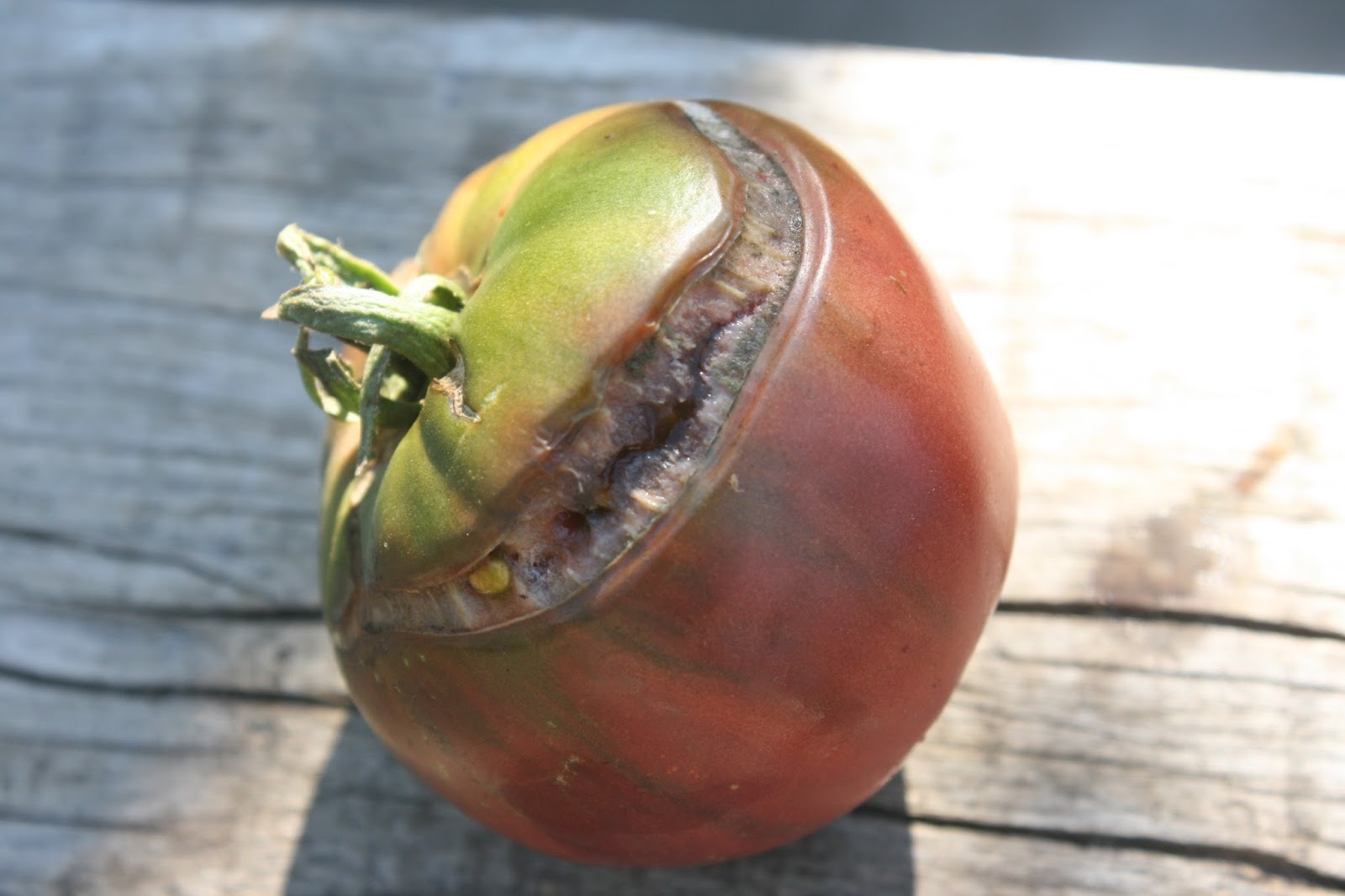
                        Cracking is the splitting of the epidermis around the calyx or stem scar (top of the tomato). There are two types of fruit cracking in tomatoes.

                        (a) Concentric cracking, which is a splitting of the epidermis in circular patterns around the stem scar. 

                        Cultivar 'Black Krim' shows high susceptibility both in green and ripe fruits  


                        (b) Radial cracking which is a splitting of the epidermis from the stem scar towards the blossom end, i.e, from top to bottom.


                        Cultivar 'Paulina F1' - a minor crack making the fruit unfit for market, but perfectly fine for processing  

                        It's possible for both types of cracks to appear at the same time

                        Why does cracking occur? 

                        Cracking depends on the ability of the epidermal cells (plant skin) to stretch. Some varieties have an epidermis that stretches well and will have very little or no circular cracking. Other varieties can have the opposite situation where they do not stretch well and have a lot of cracking.

                        From the cultivars we are growing, the most susceptible were 'Black Krim' -  an otherwise excellent tomato with incredible flavour -  and 'Rozova Magia' - a Bulgarian cultivar with huge fruits and a wonderful taste.  The table below indicates how our cultivars fared.

                        Cultivar nameColorMaturity
                        (days)
                        E, M , L
                        Genetic typeResistance
                        to Cracking
                        Season 2015
                        AlicanteRedE - 55–70Heirloomexcellent
                        Black KrimPurple/
                        Brown
                        M-L - 69-90Heirloomvery poor
                        Citrina YellowM -75-90Heirloomgood
                        Paulina BG F1RedE - 55–70Hybridmoderate
                        MarglobeRedM -75-90Heirloommoderate
                        Rozova Magia PinkM - 70–80Heirloompoor


                        When Does cracking occur? 

                        Cracking occurs as the tomato nears maturity. More susceptible varieties crack in the mature green stage and more tolerant varieties at later stages. The earlier the cracking then the deeper and longer the crack becomes. An older crack can cause a secondary problem of fungi colonising the exposed flesh. If left too long, the fruit cannot be used for processing.

                        Some kind of fungal organism developing in a deep and wide concentric crack 


                        Circular cracking can often occur on ripe tomatoes that are on the vine too long.

                        Causes of cracking 

                        1. Alterations in the growth rate - Plants have periods where they might have very fast growth followed by slow growth and then fast again. These changes can cause fruit nearing maturation to crack. If the cells have "hardened" during the last slow growth, then in the next fast growth period they may not be able to stretch enough and the epidermis cracks.

                        2. Fast growth - Some varieties have periods of very fast fruit growth with high temperatures and moisture levels.

                        3. Fruit temperature fluctuations and leaf removal - Wide fluctuations in temperature can also induce cracking. This is true especially when plants have been de-leafed too early leaving fruit without protection. The exposed fruit heats up dramatically in the sun. At night it cools relatively quickly, and the difference is bigger than it would have been had the leaves covered the fruit. The expansion and contraction of the epidermis and its cells can result in cracking.

                        4. Rain and irrigation. Rain and excess irrigation will often cause cracking and if the fruit lacks leaf cover then the effect is even more dramatic. Tomato crops that do not receive water at regular intervals but rather receive it periodically at large intervals are likely to have cracking.

                        I believe the main factor contributing to the large quantity of our tomatoes having cracks is the 3 days of heavy rainfall we had following deep irrigation of the beds. Our irrigation has been somewhat erratic this year which has also resulted in poor leaf formation so this has probably exacerbated the cracking.

                        How we will try to prevent cracking or reduce the problem of cracking  


                        1. Had we harvested the day before the heavy rain was forecast we could have saved a large percentage of the crop.

                        2. Proper water management, i.e, not over irrigating and watering at fixed intervals and increasing or decreasing quantities as needed.

                        3. Having a diversity of cultivars reduced the complete loss of a marketable crop.

                        4. Pick the split tomatoes early and use for canning, ketchup/sauces or dried tomatoes. These products can be marketed in the winter. We also picked a lot of green tomatoes and will see how they ripen in the sun, otherwise these can be used in pickles and chutneys.

                        5.Removing cracked fruit early also has the added benefit of not allowing the fungal and mould organisms to build up in your beds.


                        References 

                        Grower Solutions Magazine - Lefroy Valley April 2002
                        The Royal Horticultural Society Pests and Diseases - 1997


                        Regenerative Landscape Design - Online Interactive Course 


                        Want to learn how to design, build and manage regenerative landscapes?  Join us for our Regenerative Landscape Design - Online Interactive Course from May 1st to Sep 13th, 2023. 

                        We're super excited about running the course and look forward to providing you with the confidence, inspiration, and opportunity to design, build and manage regenerative landscapes, gardens, and farms that produce food and other resources for humans while enhancing biodiversity.

                        Regenerative Landscape Design Online Course

                        You can find out all about the course here and right now we have a 20% discount on the full enrollment fees. Just use the promo code
                         RLD2023 in the section of the registration form to receive your discount. 

                        We are looking forward to providing you with this unique online learning experience - as far as we know, the very first of its kind. If you are thinking of reasons why you should do this course and whether this course is suitable for you, take a look here where we lay it all out. Looking forward to it!


                        --------------------------------------------------------------------------------------------------------------------------

                        We offer a diversity of plants and seeds for permaculture, forest gardens and regenerative landscapes including a range of fruit and nut cultivars. We Deliver all over Europe from Nov - March. - Give a happy plant a happy home :)


                        Our Bio-Nursery - Permaculture/Polyculture/ Regenerative Landscape Plants 

                        --------------------------------------------------------------------------------------------------------------------------

                        Support Our Project 


                        If you appreciate the work we are doing you can show your support in several ways.

                        • Comment, like, and share our content on social media.
                        • Donate directly via PayPal to balkanecologyproject@gmail.com or via FTX Pay


                        --------------------------------------------------------------------------------------------------------------------------

                        Design and Create Webinars - Forest Gardens, Urban Gardens, Permaculture, Regenerative Farming   


                        We're hosting a range of online learning sessions including how to create habitat to enhance biodiversity, how to design and build a forest garden, polyculture design software tutorials, regenerative farm, and landscape design, urban gardening and much more. If you would like to be notified when our next sessions are coming up please add your email below and hit subscribe and we'll be in touch.


                        You can also register for our online training, services, and products directly here.


                        --------------------------------------------------------------------------------------------------------------------------


                        Monday, 17 August 2015

                        C4 Plants

                        What are C4 plants?

                        Basically they are plants that undertake photosynthesis in a different way enabling them to continue to grow during hot and dry conditions. To better understand this lets quickly recap on photosynthesis.

                        All plants require carbon dioxide from the atmosphere in order for photosynthesis to occur and plants obtain this carbon dioxide via tiny openings on the underside of the plant leaf, these tiny openings are called stomata. The stomata also provide the exit of H2O from the plant.


                        When soil water resources are low small openings usually on the underside of the leaves called the stomata close to reduce the loss of water from the plant. This also reduces the incoming carbon dioxide as plants absorb CO2 through these same stomata. Without C02 plants cannot photosynthesis and growth halts.  When a plant is wilting it has reached this point.
                        Some plants have adapted to overcome this and one particular group of grasses and tropical plants, the C4 plants,  are able to close stomatal pores in order to reduce water loss whilst still obtaining carbon dioxide thereby maintaining photosynthesis in hot and dry conditions.


                        Welcome to our Online Store where you can find Forest Garden/ Permaculture plants, seeds, bulbs and Polyculture multi-packs along with digital goods and services such as Online Courses, Webinars, eBooks, and Online Consultancy.  We hope you enjoy the store and find something you like :) It's your purchases that keep our Project going. Yuu can also find our full list of trees. shrubs and herbs for forest gardens on our website here 


                        C4 Plants, Examples, and C4 Families


                        They are found only in the angiosperms with about 8,000 members in 17 families equivalent to about 3% of all land plants. Combined, the grasses (family Poaceae or Gramineae) and sedges (family Cyperaceae) comprise roughly 79% of the total number of C4 species (Simpson 2010).

                        Examples of C4 species are the economically important crops corn or maize (Zea mays), sugarcane (Saccharum officinarum), sorghum (Sorghum bicolor), and millets.

                        Other examples include, couch or bermuda grass (Cynodon dactylon), barnyard grass (Echinocloa spp.), goosegrass (Eleusine indica), Johnson grass (Sorghum halepense), cogon (Imperata cylindrica), common purslane or alusiman (Portulaca oleracea), crabgrass (Digitaria sanguinalis), several species of pigweed (Amaranthus spp.), carabao grass (Paspalum conjugatum), itchgrass (Rottboellia exaltata), and Russian thistle or tumbleweed (Salsola kali) (Llewellyn 2000; Moore et al. 2003).

                        We are working on a model to use these plants to produce seed free biomass for mulching an establishing forest farm. See here for more on that.

                        Support Our Project

                        If you appreciate the work we are doing you can show your support in several ways.


                        ---------------------------------------------------------------------------------------------------------------

                        We offer a diversity of plants and seeds for permaculture, forest gardens and regenerative landscapes including a range of fruit and nut cultivars. We Deliver all over Europe from Nov - March. - Give a happy plant a happy home :)


                        Our Bio-Nursery - Permaculture/Polyculture/ Regenerative Landscape Plants 

                        Friday, 26 June 2015

                        Land Stewardship

                        We're proud to announce we have an additional 2.5 hectares protected from the encroaching monotony of intensive farming. The strategic purchasing of scattered plots throughout the area means that effectively 53.5 ha are off limits and the wonderful diversity of wild flora and fauna coupled with an extraordinary quantity of heritage fruit and nut trees in this area are much more likely to survive for our children to enjoy. 

                        New Plots purchased in June 2015 

                        Revenue from bio-nursery sales, our market gardens and educational courses sustain our project and help us to achieve our goal to protect and promote the regeneration of ecosystems here and beyond. We continue to commit to using all profit from our activities for the purchasing of land with high ecological value currently under threat from intensive agricultural development. The land, once under our stewardship, is managed with respect for its inherent value and vital ecosystem services.


                        A view from the land 


                        Regenerative Landscape Design - Online Interactive Course 


                        Want to learn how to design, build and manage regenerative landscapes?  Join us for our Regenerative Landscape Design - Online Interactive Course from May 1st to Sep 13th, 2023. 

                        We're super excited about running the course and look forward to providing you with the confidence, inspiration, and opportunity to design, build and manage regenerative landscapes, gardens, and farms that produce food and other resources for humans while enhancing biodiversity.

                        Regenerative Landscape Design Online Course

                        You can find out all about the course here and right now we have a 20% discount on the full enrollment fees. Just use the promo code
                         RLD2023 in the section of the registration form to receive your discount. 

                        We are looking forward to providing you with this unique online learning experience - as far as we know, the very first of its kind. If you are thinking of reasons why you should do this course and whether this course is suitable for you, take a look here where we lay it all out. Looking forward to it!


                        --------------------------------------------------------------------------------------------------------------------------

                        We offer a diversity of plants and seeds for permaculture, forest gardens and regenerative landscapes including a range of fruit and nut cultivars. We Deliver all over Europe from Nov - March. - Give a happy plant a happy home :)


                        Our Bio-Nursery - Permaculture/Polyculture/ Regenerative Landscape Plants 

                        --------------------------------------------------------------------------------------------------------------------------

                        Support Our Project 


                        If you appreciate the work we are doing you can show your support in several ways.

                        • Comment, like, and share our content on social media.
                        • Donate directly via PayPal to balkanecologyproject@gmail.com or via FTX Pay


                        --------------------------------------------------------------------------------------------------------------------------

                        Design and Create Webinars - Forest Gardens, Urban Gardens, Permaculture, Regenerative Farming   


                        We're hosting a range of online learning sessions including how to create habitat to enhance biodiversity, how to design and build a forest garden, polyculture design software tutorials, regenerative farm, and landscape design, urban gardening and much more. If you would like to be notified when our next sessions are coming up please add your email below and hit subscribe and we'll be in touch.


                        You can also register for our online training, services, and products directly here.


                        --------------------------------------------------------------------------------------------------------------------------