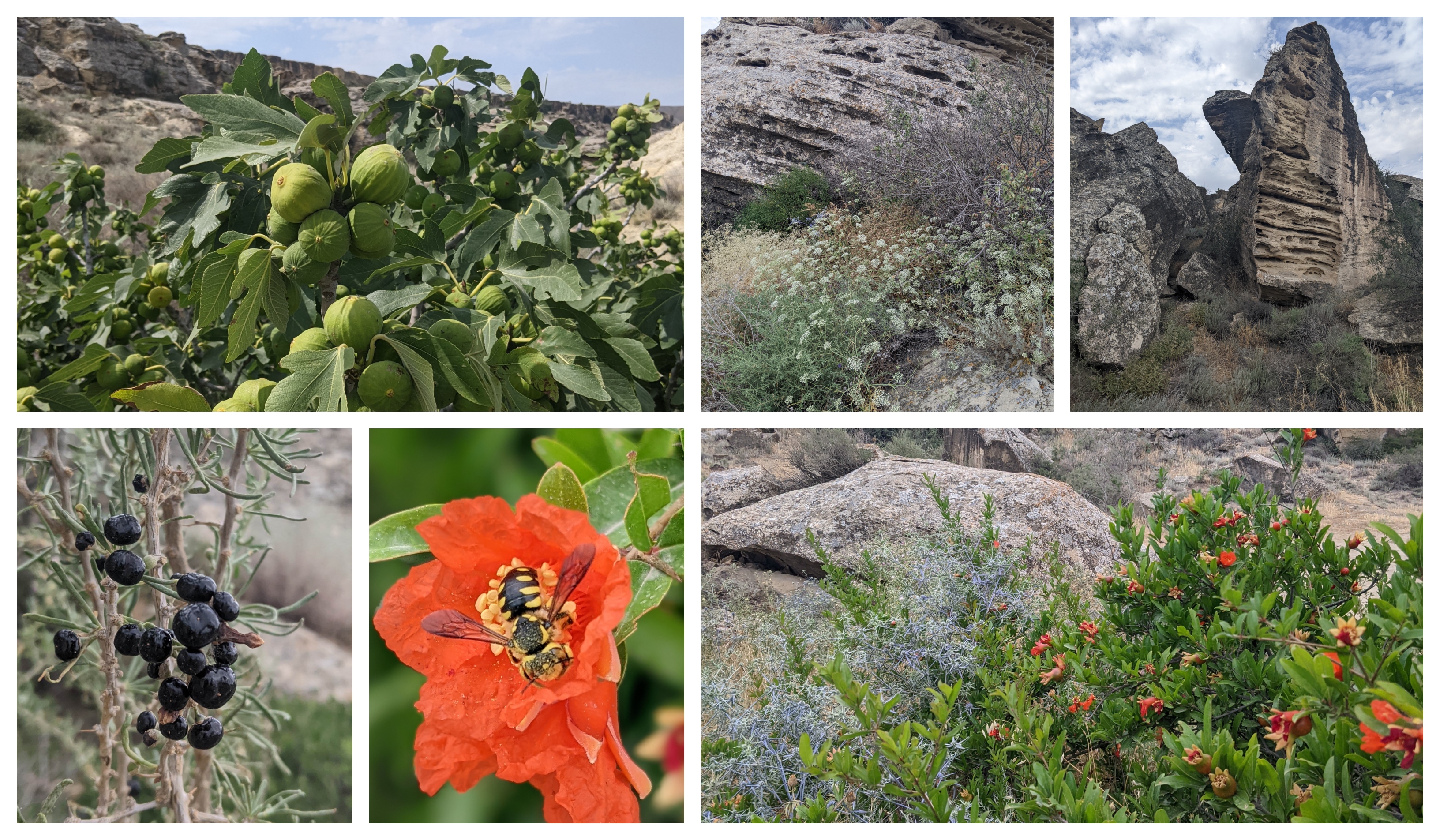
Just arrived in Azerbaijan, Baku, it's a beautiful city. During this post, I'll share some observations of the flora throughout the city and highlight a few of the many beautiful parks and areas around the city.
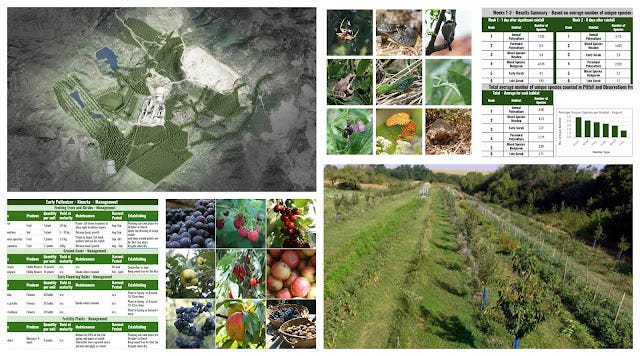
Given that Baku has a semi-arid climate receiving very little annual rainfall and practically zero during the summer months, it is a remarkably green city. The surrounding area is primarily barren with less than 0.5 percent of this territory covered in trees, as you can see from google maps below. This is predominantly due to climatic factors however there are ongoing efforts to regreen the region using a selection of native plants, with a planned planting of 30 million trees.
The city relies on a network of reservoirs and lakes within the region to store and distribute water for various purposes, including irrigation for green spaces
The Kura River, which flows through the country provides the bulk of water for irrigation in agricultural areas and has in the past been diverted to supply water for parks and green spaces in Baku. More recently wastewater treatment plants treat and purify used water, making it suitable for non-potable purposes like irrigation.
A selection of trees that are adapted to dry conditions for street planting is also in place and works well in the city keeping the vast majority of the main and side streets lush and well-shaded. Platanus oreintalis - Oriental Plane native to this region and classic city trees all over the temperate world, are frequently planted along the main streets and parks in Baku The next most common street trees in the center are probably native Pinus spp. and it seems as if every courtyard has at least one large fruiting mulberry.
The city is situated on natural terraces. On the lowest terrace before the shoreline sits the old town, a charming place full of figs, apricot, olives, grapevine, loquat, mulberry, quince, and persimmon among other ornamental plants. Although a popular tourist spot it is still very much lived in which adds to the charm and character of the place.
It's a popular location for artists and the Ali Shamsi Art Studio stands out with the incorporation of plants, painting, and sculpture into the studio facade.
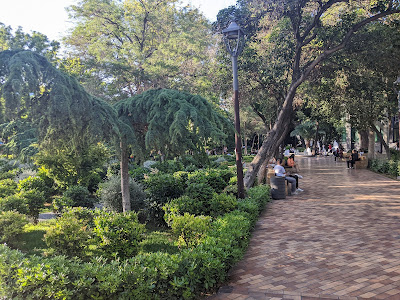
South West of the Old Town, below the Fortress walls, is Philarmonia Garden. Established in 1830, it's a bustling park, beautifully planted and landscaped. I came across a reference to a city law from the 1830s stating that all Captains coming from Iran and docking in Baku should bring a sack of soil that was used to provide the substrate for this garden.
The older parts of the garden are forest-like, with century-old trees colliding canopies (below left). Interesting to see
Elaeagnus x ebbingei - Ebbinge's silverberry (below right) border hedging growing well in the understory, probably receiving just a few hours of direct sunlight a day.
Pomegranate in full flower is on show around the city parks and streets, with fruits already starting to form. The plants were buzzing with bees, a species I'm not familiar with and have yet to identify.
On the seafront of Baku, looking out South to the Caspian Sea is Dənizkənarı Milli Park, a 3.75 km long promenade. It's perfect at sundown and features some incredible specimen trees notably a number of sculpted Olea europaea and Ceiba speciosa, the floss silk tree, a native to South America's tropical and subtropical forests.
The inclusion of native pines Pinus eldarica and Pinus kochiana along the Boulevard are well balanced with exotic and native deciduous broadleafs with topiary and flowers in the understory planted into lawns that are peppered with patches of Trifoilum spp. and Lotus corniculatus
The upper terraces of the city, housing the financial and government buildings are also surrounded by parks and fountains (there are many parks and fountains in Baku). Nerium oleander is often used to soften the modern structures in this area.
I've not seen many buildings that are significantly better looking in real life than in photos but Heydar Aliyev Centre in Baku, designed by Iraqi-British architect Zaha Hadid, is certainly one of them.
The deliberate absence of above-ground level plants around the structure, emphasizes the magnificence of the building and the surrounding city view.
The inside of the building is welcoming, inspiring, and comfortable, and does great justice to the excellent selection of artifacts on display within the various nooks and wings of the building.
The first floor is more or less what you would expect to find in an art gallery but as you venture to the upper layers, there is incredible beauty to be found. Well worth a visit to discover for yourself.
I'll end the post with a photo of the exquisite Albizia julibrissin - Silk tree. Native to this part of the world and featured in the city plantings Baku. I'm really looking forward to visiting the wild stands over the next few weeks. Other wild trees I'll be looking out for include Caucasian Alder (Alnus subcordata) - Caucasian Persimmon (Diospyros lotus) - Caucasian Wingnut (Pterocarya fraxinifolia)
That's all for now!
Regenerative Landscape Design - Online Interactive Course
Want to learn how to design, build and manage regenerative landscapes? Join us on our Regenerative Landscape Design - Online Interactive Course.
The course includes 20 lessons, with 20 hours of one-to-one mentoring/consultancy, drawn from over 20 years of experience designing, implementing and managing polyculture gardens, farms, food forests and regenerative landscapes across a variety of climate zones.
We look forward to providing you with the confidence, inspiration, and opportunity to design, build and manage landscapes that produce food and other resources for humans while enhancing biodiversity.
You can access all of the course material without the one-to-one tutoring by becoming a paid annual subscriber to our Substack, which grants you access to the Bloom Room for just 70 USD per year. Subscribe below to join now.
I look forward to having you join us!
Support Our Project
If you appreciate the work we are doing you can show your support in several ways.