Part 1. Introduction to Comfrey
A member of the Borage family, Comfrey - Symphytum spp. is native to Europe and Asia and there are 40 recorded species of Comfrey throughout that region. The plant most commonly referred to and used in gardens is Russian Comfrey - Symphytum x uplandicum, a naturally occurring hybrid of two wild species: Common Comfrey - Symphytum officinale and Prickly Comfrey - Symphytum asperum.
 |
Comfrey 'Bocking 14' in the understory of a Walnut - Juglans regia in our Forest Garden
|
A few centuries back the hybrid Symphytum x uplandicum came to the attention of an original ecotrepreneur Henry Doubleday (1810 – 1902) and he widely promoted the plant as a food and forage crop. Years later, and after two world wars, Lawrence D Hills (1911–1991) would continue Henry Doubleday's Comfrey crusade.
In the 1950s Hills developed a Comfrey research program in the village of Bocking, near Braintree in the UK. The original trial site is on the plot of land now occupied by the Doubleday Gardens housing development. Lawrence Hills lived at 20 Convent Lane just around the corner from the trail site.
 |
| The area highlighted in red was the site of the Bocking trails. Today, it is home to the housing development named Doubleday Gardens in memory of Henry Doubleday. The red dot is where Hills lived. |
At this site Hills trialed 21 Comfrey "strains" gathered from other growers around the country. He named the "strains" after the village Bocking and gave each one a number.
Strain fourteen was identified as being the most nutrient-rich non-seeding strain and
'Bocking 14' began its journey into gardens far and wide across the world.
As a consequence of his research into comfrey and organic gardening, Hills founded HDRA (Henry Doubleday Research Organization). HDRA moved from Bocking to Wolston, near Coventry at the present site of
Ryton Organic gardens in 1985, where today you can find ten acres of fully landscaped organic gardens. HDRA is now known as
Garden Organic and is one of the worlds leading organic gardening organizations.
It's amusing to think how the chance offspring of two wild plants can have so much influence!
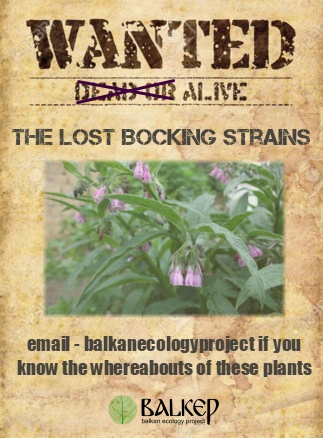
Regarding the other 20 strains, it appears all but 'Bocking 4' are lost. I'll be visiting
Ryton Gardens in the summer to see if I can track down "the lost Bocking strains". If anyone has any other idea where they can be found please get in touch!
Medicinal Use - Comfrey has been cultivated, at least, since 400 BC as a healing herb. The Greeks and Romans commonly used Comfrey to stop heavy bleeding, treat bronchial problems and heal wounds and broken bones. Poultices were made for external wounds and tea was consumed for internal ailments. Comfrey has been reported to promote healthy skin with its mucilage content that moisturizes and soothes and promotes cell proliferation. This plant is my first port of call if ever I need to dress a wound. Simply take a few leaves, brush them together to remove the hairs and wrap them around the wound and apply light pressure. It's incredibly effective at stopping the bleeding, reducing the pain, and healing the wound.
Biomass - Comfrey produces large amounts of foliage from late May until hard frosts in October or November. The plant is excellent for producing mulch and can be cut 2 - 5 times per year depending on how well the plants are watered and fed. The plant grows rapidly after each harvest.
In our gardens, we have
Comfrey 'Bocking 14' located next to each fruit tree in order to have a renewable source of mulch just where we need it. We also grow in patches as part of our fertility strategy in the market garden and have patches in the wildflower meadows.
(details below).
We recently supplied 1000 'Bocking 14' cuttings to
Oxygenisis a business in Germany who are experimenting with using this plant for carbon capture.
Mineral Dam – According to
Roots Demystified by Robert Kourik, Comfrey has deep roots of up to 50 - 60 cm. The roots can utilize nutrients in the subsoil that would otherwise wash away with the underground soil water or remain inaccessible to other plants. The nutrients - once taken up from the roots - are relocated throughout the plant as and where needed with some of them ending up in the Comfrey leaf mass. When cutting the leaf mass and applying to the soil surface the mined nutrients are returned and again made accessible to shallower-rooted crop plants.
Biodiversity - The bell-shaped flowers provide nectar and pollen to many species of bees and other insects from late May until the first frosts in late Autumn. Lacewings are said to lay eggs on Comfrey and Spiders overwinter on the plant. Parasitoid Wasps and Spiders will hunt on and around Comfrey.
 |
| Xylocopa violacea - Violet carpenter bee feeding from our comfrey patch |
Pest and Disease Prevention and Control - Research indicates that a comfrey solution can be used to prevent powdery mildew. Pest predators such as spiders, lacewings, and parasitoid wasps associate with this plant. Its best to leave some plants alone in order to sustain pest-predator relationships.
Ground Cover – Some species can quickly spread to form a thick ground cover and work particularly well for ground cover on the sunny side under shrubs and trees.
Symphytum tuberosum - Tuberous Comfrey is a great ground cover option.
Fertilizer - Comfrey leaves contain a great balance of major plant nutrients (N,P, K) and can be fed to plants as powder, direct mulch or by steeping chopped Comfrey leaves in water for several weeks to produce a thick, dark liquid that can be diluted with water and applied to plant roots. More on this below.
Nutritional Value of Comfrey - You can see from the below table that wilted Comfrey contains significantly higher quantities of Potash compared to other organic fertilizers. Its well recorded that Comfrey is an excellent source of potassium (K) a major
plant nutrient that is required by plants in large amounts for proper growth and reproduction.
 |
| Taken from Lawrence D.Hills - The Comfrey Report |
Animal Fodder - Comfrey has a long history of use as an animal feed. Lawrence D Hills dedicated books to this topic*. The leaves are best received by animals wilted. Fresh leaves can be eaten by pigs, sheep, and poultry but cattle, rabbits and horses will usually only consume wilted leaves.
Human Consumption - Symphytum officianale and Symphytum x uplandicum are both reported to be used for salad and potherb and are best when cooked. Personally, I'm not keen on the texture but will have the occasional nibble from the garden using the new growth to mix in a spring green salad.
Caution - Although Comfrey has been used as a food crop, in the past 20 years scientific studies reported that Comfrey may be carcinogenic since it appeared to cause liver damage and cancerous tumors in rats. These reports have temporarily restricted the development of Comfrey as a food crop. In light of this, the regular consumption of Comfrey is not advisable.
Plant Description
Life cycle - Herbaceous perennial
Growth habit - Comfrey begins growth in early spring and compact clusters of young leaves are soon visible in the crown of the old plant. Around late spring, the leaf blades with long petioles have grown to over 35 cm high. Basal leaves are large, lance-shaped, stalked, and coarsely hairy. The leaves die back following the first frost and remain dormant for winter. Many species can spread vigorously via seed and are generally not welcome in the garden because of this. Other species can spread via tubers and all species quickly regenerate from broken root pieces.
Flowering - Starts in late May or early June and continues until the first frost in late Autumn. The bell-shaped flowers with pedicels are in terminal cymes or one-sided clusters. Flowers of Common Comfrey are usually creamy yellow, but white, red, or purple types have been found in Europe. Prickly Comfrey has pink and blue flowers while Russian Comfrey has blue, purple, or red-purple flowers.
Tuberous Comfrey has creamy white flowers. Vegetative growth does not cease with the start of flowering, and the plant will add new stems continuously during the growing season. Most comfrey plants can be somewhat invasive spreading via seed to parts of the garden where they are not wanted. 'Bocking 14' will flower and provide nectar and pollen but will not produce viable seeds.
 |
| The first flowers of spring. |
Roots - Some plant species have short, thick, tuberous roots such as
Symphytum tuberosum. Others such as Symphytum x uplandicum have deep and expansive root systems.
 |
| 'Bocking 14' root system from our market garden. The roots extended at least 50 cm down within the first 5 months of growth |
Plant Requirements
Light - Needs full sun for good biomass production but grows fine in the shade.
Shade - Tolerates light shade (about 50%)
Moisture - Some species are drought tolerant e.g
Symphytum tuberosum. Cultivated plants require irrigation.
USDA Hardiness Zone - 4-9 Comfrey crowns and roots are very winter hardy
Soil - Comfrey is adaptable to many soils, but prefers moist, fertile soils.
pH - Tolerates a wide range (6.5-8.5) Although not very sensitive to soil pH, the highest yields are reported to occur on soils with a pH of 6.0 to 7.0
Welcome to our
Online Store where you can find Forest Garden/ Permaculture plants, seeds, bulbs, and
Polyculture multi-packs along with digital goods and services such as
Online Courses, Webinars,
eBooks, and Online Consultancy.
Part 2. How to set up and manage a Comfrey patch
Setting up a Comfrey Patch
Perhaps you're interested in growing comfrey to feed your animals, for medicine, for mulch, for compost or you're slightly masochistic and want to roll around naked in the pricky beds of biomass (not me ) In any case, here's how to do it.
The plant we use in our gardens is
Symphytum x uplandicum - 'Bocking 14' , a sterile cultivar that produces copious quantities of nutrient-dense biomass. The following information is based on using this plant.
- We're growing for biomass and want the plants to receive as much light as possible. Accordingly, we lay out our beds on an east-to-west axis (we're in the northern hemisphere).
- Irrigation is necessary if you want to get good yields from plants. In dry climates picking a place with access to reliable irrigation is of paramount importance.
- In areas of low rainfall using the gradient of the land to channel precipitation toward your beds will reduce the water needs of your plants. In areas of high rainfall with a high water table, you should consider diverting water away from the beds.
- Once established, Comfrey is difficult to get rid of, so choose a site where you want it to stay. Don't plant Comfrey in any area you cultivate as the broken root pieces quickly establish into new plants and can out-compete the slower-growing crops.
- Positioning Comfrey downhill from where you expect leachate to be present, i.e downhill from a manure pile , compost heap, outside toilet, animal pen, etc, can provide passive fertility to the plants and rescue otherwise lost minerals from draining away with the subsoil ground water.
- Grow the comfrey where you want to use it. As you'll see later we may be harvesting over 1/4 ton biomass from our patch and don't want to be carrying that over long distances
Preparing the site - Raised beds are a major part of our fertility strategy and over time retain water and nutrients very efficiently. I use 1.3 m wide beds surrounded by 50 cm paths for our crops as this allows easy access for harvesting everywhere in the beds without ever having to tread on the soil and the paths are wide enough to take our lawnmower.
Here is an example of a 10 m long comfrey bed on our site.
 |
| Diagram of a Comfrey Bed from our Market Garden |
To form a bed the area should be cleared of all plants, best achieved by sheet mulching the season before. Pernicious perennials or tap-rooted biennials should be dug out. After you have cleared the whole area, mark out the bed shape with string and dig out 50 cm wide paths around your beds applying the soil to the surface of the planting area thereby creating the initial rise of the bed. Fork over the beds well. If a hard pan is present take the time and effort to eliminate it before planting.
 |
| Raised beds in our Market Garden |
Depending on the quality of your soil you may want to add extra compost before planting into the bed. If you have sheet mulched the area beforehand all you need to do is add a good 20 cm thick of straw mulch (or some other mulch) and it's ready for planting. A good mulch to start with will help keep the weeds down while your comfrey gets going.
You can alter the depth and gradient of the paths to facilitate the required direction of water movement.
Planting Material - You can plant out with crown divisions or root cuttings best done in the spring when the soil has warmed. A crown division can be obtained by simply putting a spade through the center of a mature comfrey plant and transplanting the divided sections. For our beds, I divided 2 yr old plants into quarters sometimes sixths and these established very well in the first year. Its bests not to harvest the leaf biomass in the first year in order to allow a deep root system to develop. However, if you use large divisions you can start harvesting in July.
 |
| Our Comfrey Beds 6 weeks after planting |
Root cuttings are a great way to plant out large areas of Comfrey. The cuttings should be grown in small pots with 50% compost and 50% river sand mix kept moist and planted out in the spring as soon as the first leaves emerge and the soil has warmed. If you are planting large numbers of root cuttings you can plant directly into the beds by creating "nests" in the straw, adding two cupped handfuls of the above-mentioned potting mix, and planting the cuttings into this. Keep them moist like a wrung-out sponge and the success rate will be very close to 100%
 |
| 'Bocking 14' root cuttings from our Bionursery |
Spacing - The plants should be spaced 60 cm apart in rows and 60 cm apart at diagonals between rows. Plant the rows 15 cm from the edge of the beds.
 |
| Comfrey planting plan |
Maintenance
Cutting - In the first year allow the plants to establish so that the roots develop well and penetrate deep into the subsoil. Remove any weeds around the plants leaving them on the surface. The following year the cutting can begin. You can scythe the beds for a quick harvest or cut each plant individually with a pair of secateurs or shears cutting to 5 or so cm from ground level. Watch out you don't pull any root pieces up with the leaves as they may regrow wherever they land.
The leaves are prickly so if you have sensitive hands wear gloves. Cut the Comfrey as the flowering stalks emerge up to 4 times a year. Allow the plants to flower at least once during the season to provide bee fodder to a range of native bees and honey bees. Leave the last flush of leaves before the winter so that invertebrates can find winter shelter in the undergrowth. You may need to weed between cuts every now and then but generally, the comfrey will quickly cover the surface.
Feeding - After you have cut the Comfrey, mow the pathways between the beds and empty the trimmings around the base of the Comfrey plants. Any trimmings from lawns and hedges in the surrounding area can also be used.
We are experimenting with growing nitrogen fixing hedging and ground cover plants adjacent to the patch in order to feed our comfrey. We call this the biomass belt and you can read about the design of this polyculture along with species lists and how to establish and manage this
here.
An excellent comfrey feed is an undiluted urine applied at a rate of approx 500 ml per plant twice per growing season.
Click here for a previous post on using urine as a fertilizer.
Irrigation - Comfrey will produce more biomass if irrigated and in dry climates, it's essential to irrigate. Comfrey plants wilt very fast in hot conditions and will stop photosynthesizing at this point.
20 L m2 per week of drought should be more than adequate. The beauty of biological systems is that, if managed properly, each year the soils improve and the ability of the soil to store water will improve over time.
We use a passive irrigation system diverting water from a mountain stream into the paths around the beds. The paths fill with water, we raise the level by blocking the low points with sacks of sawdust and the water is drawn throughout the soil via capillary action.
 |
| Passive irrigation in our market garden.The paths fill with water and the water permeates throughout the soil via capillary action |
How we use the comfrey
As Mulch - Freshly cut Comfrey leaves make good mulch because they have high nitrogen content, and don't pull nitrogen from the soil while decomposing. Comfrey's high potassium content makes it especially beneficial for vegetables such as tomatoes, peppers and cucumbers, berries, and fruit trees.
With adequate feed and watering, we've seen yields of 2 - 3 kg of biomass per plant per cut.
 |
Comfrey beds establishing well. This bed was planted with divided crowns 5 months prior to this photo being taken
Regenerative Landscape Design - Online Interactive CourseWant to learn how to design, build and manage regenerative landscapes? Join us on our Regenerative Landscape Design - Online Interactive Course. The course includes 20 lessons, with 20 hours of one-to-one mentoring/consultancy, drawn from over 20 years of experience designing, implementing and managing polyculture gardens, farms, food forests and regenerative landscapes across a variety of climate zones. We look forward to providing you with the confidence, inspiration, and opportunity to design, build and manage landscapes that produce food and other resources for humans while enhancing biodiversity. You can access all of the course material without the one-to-one tutoring by becoming a paid annual subscriber to our Substack, which grants you access to the Bloom Room for just 70 USD per year. Subscribe below to join now. I look forward to having you join us! |
Expected Yields
Here are some records from Lawrence D.Hills (Comfrey Report) supplied to him by UK gardeners in the 1960's
Harvest date
1960 | Weight lbs | kg | | Harvest date
1961 | Weight lbs | kg | | Harvest date
1960 | Weight lbs | kg |
| April 18th | 18 | 8.164656 | | 9th May | 94 | 42.637648 | | 25th May | 88 | 39.916096 |
| June 5th | 88 | 39.916096 | | 13th July | 147 | 66.678024 | | 13th July | 56 | 25.401152 |
| July 24th | 52 | 23.586784 | | 1st Sep | 73 | 33.112216 | | 4th Sep | 110 | 49.89512 |
| Sep 18th | 63 | 28.576296 | | 5th Nov | 19 | 8.618248 | | 6th Nov | 12 | 5.443104 |
| 221 | 100.243832 | | | | 151.046136 | | | | 120.655472 |
| based on 12 plants | Average
per plant kg | 8.353652667 | | based on 34 plants | Average
per plant kg | 4.442533412 | | based on 34 plants | Average
per plant kg | 3.548690353 |
We started our own trails in the Spring of 2016 and from a 13 m2 patch we harvested a total of 96.92 kg of comfrey leaves. This was obtained from four cuts. You can find out the details of this trial
here.
Liquid Fertiliser - What I like to call "Comfert" Fill a barrel, preferably with a bottom tap and a gauze on the inside (to prevent clogging) about 3/4 full with freshly cut Comfrey and add water to fill the barrel. Cover it, and let it steep for 3 to 6 weeks. The smell from the resulting liquid is far from attractive so approach with caution :) The tea may be used at full strength or diluted by half or more. Don't apply before heavy rain is forecast as most of the nutrients suspended in the liquid will wash straight through the soil. For the best results apply the feed to your vegetables when they are in most need of extra fertility. This will be different for each crop - for example, tomatoes are best fed when they are setting fruit and then any time during the fruiting period. Applying comfert before this can be counterproductive and make your plants more susceptible to pest problems. The black slurry at the bottom of the barrel can be dispersed evenly back over the Comfrey patch.
Liquid fertilizer concentrate -"Comfert Plus" can also be made by packing fresh-cut comfrey tops into an old bucket, weighing them down with something heavy, covering them tightly, and waiting a few weeks for them to decompose into a black slurry. You can put a hole in the bottom of the bucket and collect the concentrate in another container as it drips out. Dilute this comfrey concentrate about 15 to 1 with water, and use as you would Comfert. You can seal this concentrate in plastic jugs until you are ready to use it.
Warning! - A word of warning! If you get comfert on your hands you will literally have to wait for your skin cells to shed before you get the smell off. Wearing gloves helps!
Plant Nutrient Value of Comfrey
According to Martin Crawford in
Creating a Forest Garden: Working with Nature to Grow Edible Crops one cut of comfrey from one plant contains 0.5g of Nitrogen (N) and 10g of potassium (K) to crops.
Based on this I calculated how much Potassium (K), Nitrogen (N), and biomass the 13 m2 comfrey patch can potentially produce in a year.
| Annual Comfrey Outputs for 13 m2 Raised Bed | |
| Total Biomass (kg) | 97 kg |
| Total Comfrey cuts per year | 208 |
| Potassium (K) supplied per year | 2.08 kg |
| Nitrogen (N) supplied per year | 104 g |
Based on 52 plants cut four times a year
Average biomass of 5.5 kg per plant | |
Below is a table indicating how many comfrey cuts are needed to meet the Nitrogen and Potassium needs of various moderate and heavy cropping fruit and nut trees and annual vegetables.
| | Annual Requirement | | |
| Nitrogen(N) Supply To Sustain Cropping | Moderate Croppers
3g/m2 | Heavy Croppers 10g/m2 | Annual vegetables
37g/m2 |
| 0.5g/cut | | 4 cuts applied to each m2 | 16 cuts applied to each m2 | 60 cuts applied to each m2 |
| | | | |
| Potassium (K) Supply To Sustain Cropping | Moderate Croppers
3g/m2 | Heavy Croppers 10g/m2 | Annual vegetables
37g/m2 |
| 10g per cut | | 1/3 of cut plant applied to each m2 | 1 cut applied per m2 | 4 cuts applied per m2 |
Table adapted from Martin Crawford's Creating a Forest Garden:
In 2016 we started our comfrey trials measuring the inputs and outputs of a 13 m2 patch of Comfrey. For information on this trial see here.
Biodiversity
In order to provide a habitat for nesting spiders and invertebrates the last growth of Comfrey leaves can be left uncut before the winter. We also allow the plants to flower at least once between cuts to provide bee fodder to a range of native bees as well as honey bees and leave some plants around the garden untouched.
 |
| Here's a few plants we planted into a wildflower meadow patch of the market garden. This area is cut once a year and dried for the rabbits winter hay. |
Its worth noting that cutting back the flowering Comfrey when neighboring crop plants are in flower will drive the pollinators to your crops increasing the likelihood of successful pollination.
 |
Photos of invertebrates on our Comfrey plants - by Peter Alfrey
|
Voila! You are now ready to embark upon your own Comfrey Crusade and start growing this fabulous plant
Root cuttings and crowns come from our bio nursery and are 100% biologically grown - Click here for crowns and here for cuttings.
References
For more on Lawrence D.Hills findings on Comfrey see his book
Comfrey Past, Present and Future . You can also find the below books of Lawrence D Hills books for free at
Soil and Health library.
Thank you to Dr Francis Raynes from Coventry University for informing me on the history of the Bocking sites.
Support Our Project
If you appreciate the work we are doing you can show your support in several ways.