Sunday, 14 June 2020

Floating Aquatic Island Update, Annual Polycultures, and some Perennial Flowers - Week 13 The Polyculture Project

This week brings some new flowers into bloom, the first flush of blackcurrants and Mulberries, and with some frequent and heavy bursts of rain the annual polycultures are really starting to put on some growth.

Here's what we've been up to in the gardens this week 


Last year together with The Polyculture Project 2019 crew, we built a floating aquatic island to support the wildlife in the irrigation reservoir over at Katelepsis, the volunteer/crew house. Unlike our other ponds that have been designed primarily to attract wildlife, this reservoir has no edges which would make life difficult for any aquatic plants or amphibians that decide to reside here. In addition, rectangular water bodies do not provide the proper habitat for wildlife to flourish and can become breeding grounds for mosquitoes due to the fact that frogs and fish that prey upon the mosquito larvae are unable to survive in such conditions, so it's definitely a good idea to come up with a solution. In the below image you can see the reservoir on the east side of the property with the two downpipes diverting rainwater from the roof into the lined pit. 


In the above photo, the reservoir was empty because it was at the end of the season and the water had been used to irrigate the garden.  Today, in the below photo, the reservoir is still empty, but this time because one of the surrounding stones fell in and ripped the liner with its sharp edge! The liner used for this pond is tri-laminate LDPE, and according to a specialist in an aquatic center, it is unfortunately notoriously tricky to fix. We have ordered the product that was recommended to us and hope to successfully repair the tear in the coming days in order to capture the rainfall in what is normally the wettest month of the year in our location.

The reservoir in June 2020. You can see how well established the plants in the rockery in the foreground have become after just one season's growth.

So, back to the small aquatic habitat island for the reservoir. The design is basically a wooden pallet that has empty plastic bottles with lids attached to the bottom with wire. This allows the pallet to float in the water. We then added some plant pots, pushing the wire through the top of the pots, and placed them in position.

                    The wire threaded through the top of the plant pots will help secure them in place.                           

The aquatic plants do not need the soil in the pots to survive as they will take their nutrients directly from the water, but for this to work, it's essential that the bottom of the plant pots are in the water. The soil should provide the extra weight needed to make sure the bottom of the pots are submerged. You could also use pebbles or sand.   


On the left the plants on the floating island are getting ready to go into the reservoir. Nine months later on the right, in full leaf. The straw you see on the right-hand side of the island was mulch on a nearby plant bed that fell in, but the lizards and snakes love it and hide out there. For a more detailed description of how we made the island, please see here.


The first Orange Day Lily - Hemerocallis fulva is in flower today, and what a beautiful bloom it is too. 


                                              Orange Day Lily - Hemerocallis fulva in flower

Famous for it's beautiful orange flowers, which are edible, the Daylily is adaptable, very tolerant of lots of different soil types, and highly attractive to a range of pollinators including butterflies. PFAF gives the plant a 5/5 edibility rating, listing the tubers and leaves as also being edible. Reportedly, Daylily flowers last just one day, but each of the many stalks bears numerous flower buds, so the actual bloom time is much longer - more like weeks. Having started writing this yesterday and making a point of checking the flower today, I can indeed confirm the reports are true - the flower in the photo above has gone. Due to its spreading nature it's great for mass plantings and erosion control.   The plant in our garden is really happy growing in the shade, creeping along the boundary wall of the property, making it an ideal candidate for shady groundcover or a border.


                          Hemerocallis fulva - Orange Daylily  growing by the perimeter of the garden at Katelepsis


We are also growing Orange Daylilly in this polyculture that you can find more about here 


The annual vegetables are doing really well at the moment, enjoying the balance of the recent heavy rains with long, warm and sunny periods. We've been experimenting with a new annual polyculture of tomatoes, french beans, basil, marigold, cabbage and garlic. 

                                                          Annual polyculture with cabbage


 We're also growing our usual annual polyculture Zeno at the residential house.
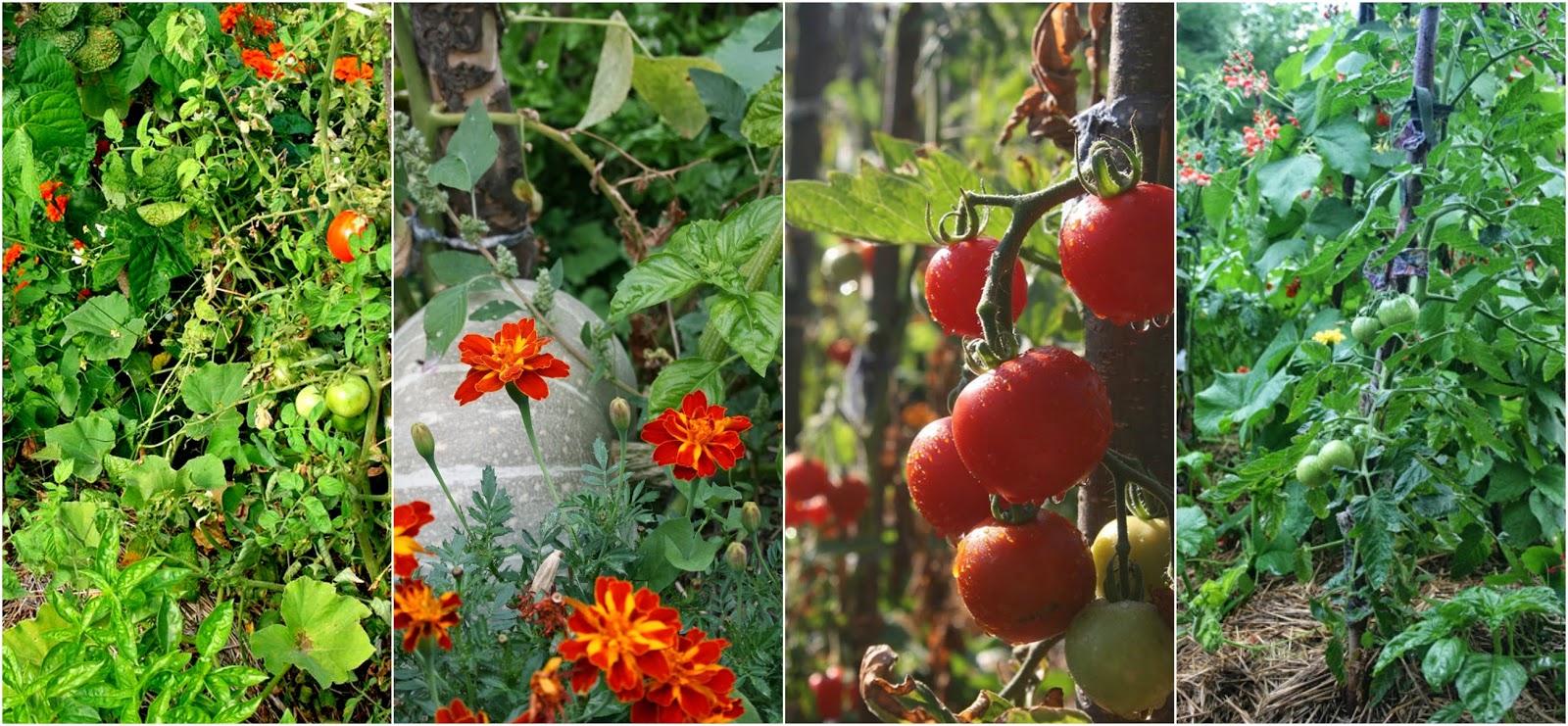

                                                           Some photos from Zeno

Zeno Plant List  - The following plants are used in this polyculture;

Tomato - Solanum lycopersicum 
Basil - Ocimum basilcium 
French Beans - Phaseolus vulgaris 
Courgette - Cucurbita pepo
Butternut Squash - Cucurbita pepo 
African Marigold - Tagetes erecta
French Marigold - Tagetes patula
Pot Marigold - Calendula officinalis 

It's been very successful in our home gardens for the last 10 years, and back in 2015, we scaled it up for the market garden for a 5-year comparative study. You can find the results here. For more info on plant spacing, management and maintenance of this polyculture see our previous post here. 

It's interesting to think about planning annual polycultures in terms of layers like you might design a forest garden. When working with herbaceous plants, the tallest plant in the polyculture becomes the canopy. With good selection, the benefits of plant layering i.e, resource sharing in time and space, can work well with whatever plants you use. For example in the below photo, you can see the layering of Zeno - where tomatoes are the canopy layer, basil, and marigold the shrub layer, butternut squash a ground layer, beans a vertical layer and the wild natives that grow around the edges could be considered a herb layer.

                                                      Layers in Zeno, an annual polyculture

Regenerative Landscape Design - Online Interactive Course 


Want to learn how to design, build and manage regenerative landscapes?  Join us for our Regenerative Landscape Design - Online Interactive Course from May 1st to Sep 13th, 2023. 

We're super excited about running the course and look forward to providing you with the confidence, inspiration, and opportunity to design, build and manage regenerative landscapes, gardens, and farms that produce food and other resources for humans while enhancing biodiversity.

Regenerative Landscape Design Online Course

You can find out all about the course here and right now we have a 20% discount on the full enrollment fees. Just use the promo code
 RLD2023 in the section of the registration form to receive your discount. 

We are looking forward to providing you with this unique online learning experience - as far as we know, the very first of its kind. If you are thinking of reasons why you should do this course and whether this course is suitable for you, take a look here where we lay it all out. Looking forward to it!

What we think is a Spanish Dagger Tree - Yucca gloriosa, is just starting to bloom in the garden of Katelepsis, the crew house. It ain't called a 'Dagger Tree' for nothing - the leaves are very sharp and can easily pierce the skin and probably tougher substances. I'm not surprised to learn that they are often used as security guards and planted outside windows or near houses, like a living security hedge! Native to southern regions of the US and Mexico, and hardy to zones 6 - 11, Spanish Dagger Tree has been used for centuries in basket making, clothing, and footwear.  PFAF gives it an edibility rating of 3/5 and many sources describe the flowers as edible, absolutely delicious, and can be eaten raw or fried (I haven't tried it yet).  Highly ornamental, this interesting plant could be a worthy candidate for a spot in a dry area due to its ability to be drought resistant, as well as tolerating maritime exposure. It gets pretty tall, growing to 2m by 1.2m, which gives it quite a striking appearance.


  Welcome to our Online Store where you can find Forest Garden/ Permaculture plants, seeds, bulbs and Polyculture multi-packs along with digital goods and services such as Online Courses, Webinars, eBooks, and Online Consultancy.  We hope you enjoy the store and find something you like :) It's your purchases that keep our Project going. Yuu can also find our full list of trees. shrubs and herbs for forest gardens on our website here 


Spanish Dagger Tree - Yucca glorisa, The flowers of the Spanish Dagger Tree - Yucca gloriosa


Regenerative Landscape Design - Online Interactive Course 


Want to learn how to design, build and manage regenerative landscapes?  Join us for our Regenerative Landscape Design - Online Interactive Course from May 1st to Sep 13th, 2023. 

We're super excited about running the course and look forward to providing you with the confidence, inspiration, and opportunity to design, build and manage regenerative landscapes, gardens, and farms that produce food and other resources for humans while enhancing biodiversity.

Regenerative Landscape Design Online Course

You can find out all about the course here and right now we have a 20% discount on the full enrollment fees. Just use the promo code
 RLD2023 in the section of the registration form to receive your discount. 

We are looking forward to providing you with this unique online learning experience - as far as we know, the very first of its kind. If you are thinking of reasons why you should do this course and whether this course is suitable for you, take a look here where we lay it all out. Looking forward to it!

--------------------------------------------------------------------------------------------------------------------------

We offer a diversity of plants and seeds for permaculture, forest gardens and regenerative landscapes including a range of fruit and nut cultivars. We Deliver all over Europe from Nov - March. - Give a happy plant a happy home :)


Our Bio-Nursery - Permaculture/Polyculture/ Regenerative Landscape Plants 

--------------------------------------------------------------------------------------------------------------------------

Support Our Project 


If you appreciate the work we are doing you can show your support in several ways.

  • Comment, like, and share our content on social media.
  • Donate directly via PayPal to balkanecologyproject@gmail.com or via FTX Pay


--------------------------------------------------------------------------------------------------------------------------


Design and Create Webinars - Forest Gardens, Urban Gardens, Permaculture, Regenerative Farming  


We're hosting a range of online learning sessions including how to create habitat to enhance biodiversity, how to design and build a forest garden, polyculture design software tutorials, regenerative farm, and landscape design, urban gardening and much more. If you would like to be notified when our next sessions are coming up please add your email below and hit subscribe and we'll be in touch.


You can also register for our online training, services, and products directly here.

--------------------------------------------------------------------------------------------------------------------------

Tuesday, 2 June 2020

Pest Predators. Ducks and Mustelids and Cherries in the Forest Garden - Week 11 - The Polyculture Project

It's been much cooler weather this week with a daytime temperature falling from 32°c one day to 12°c the next! The cooler spell has brought with it rain, that the gardens seem to be appreciating and is slowing down the pace of growth. A welcome pause.

So here's what we've been up to in the gardens this week


The cherry trees are lovely and ripe now although we've been eating them for the last week and should have another 5 or 6 days before they fully ripen. The photos below show cherries picked from the same tree, the photo on the left picked 7 days before the photo on the right. I'll get a photo next week for comparison, but it's definitely worth the wait for those darker fruits.


Lunaria annus - Perennial Honesty, seeds developing in the pods. It's a great self-seeding annual and is spreading around our perennial beds attracting a lot of interest from bees and butterflies when in flower. All parts of the plants are edible. The leaves can be used as a green vegetable or in salads before the flowers appear, the flowers can be added to salads,  the seeds can be used to make a mustard substitute and the root can be peeled and eaten. 

 
One of our early potato plants has started to flower, which can be considered as a signal to start mounding up the potato plant as it signals the stems are mature enough and have enough leaf mass to start forming tubers.


This year, we are experimenting with using wet straw in our potato beds instead of using traditional mounding up methods.  We collect spoiled straw bales from a local farmer who can't use the straw for animal bedding but they are ideal for mulch. We store them outside until needed and as they are outside without cover, the bales get wet in places which makes them ideal mulch to apply to the potato beds, as the straw has some weight to it when wet. We'll see how well this method works when it's time to harvest them in late June/early July.


Welcome to our Online Store where you can find Forest Garden/ Permaculture plants, seeds, bulbs and Polyculture multi-packs along with digital goods and services such as Online Courses, Webinars, eBooks, and Online Consultancy.  We hope you enjoy the store and find something you like :) It's your purchases that keep our Project going. Yuu can also find our full list of trees. shrubs and herbs for forest gardens on our website here 
Potato -  Solanum tuberosum, growing in straw

We're in week 5 of Regenerative Landscape Design - Online Interactive Course where we cover what you need to know about a site in order to make the best design decisions. It's a great place to start if you are considering developing any type of garden or farm including, forest gardens, market garden agroforestry etc. 


We're super excited about running the course and look forward to providing you with the confidence, inspiration, and opportunity to design, build and manage regenerative landscapes, gardens, and farms that produce food and other resources for humans while enhancing biodiversity. Read on for how you can sign up to class of 2021.

Regenerative Landscape Design - Online Interactive Course 


Want to learn how to design, build and manage regenerative landscapes?  Join us for our Regenerative Landscape Design - Online Interactive Course from May 1st to Sep 13th, 2023. 

We're super excited about running the course and look forward to providing you with the confidence, inspiration, and opportunity to design, build and manage regenerative landscapes, gardens, and farms that produce food and other resources for humans while enhancing biodiversity.

Regenerative Landscape Design Online Course

You can find out all about the course here and right now we have a 20% discount on the full enrollment fees. Just use the promo code
 RLD2023 in the section of the registration form to receive your discount. 

We are looking forward to providing you with this unique online learning experience - as far as we know, the very first of its kind. If you are thinking of reasons why you should do this course and whether this course is suitable for you, take a look here where we lay it all out. Looking forward to it!

​Prunus nipponica - Japanese Alpine Cherry fruits. As the name suggests this plant originated in Japan often found on mountainsides. A deciduous small tree or shrub with beautiful serrated green leaves, it makes a popular choice in the garden as an ornamental tree. Its pale pink flowers in early spring give way to unusual red husks that stay on the tree for a considerable time after the blooms have finished.. It is one of the hardiest cherry trees and helpfully suits a variety of soils. This "Brilliant" variety is a compact, bushy tree attracting many useful pollinators to the garden.


Ginkgo biloba - Maidenhair Tree leaves on our 2-year-old plants 


I found this Ichneumon wasp in the sunroom, a great pest predator.  Although that ovipositor looks alarming, they cannot deliver a sting as many wasps or bees do. Interestingly, it's used to lay eggs. Some ichneumonid species lay their eggs in the ground, but most inject them either directly into their host's body or on its surface. After hatching, the ichneumonid larva consumes its still-living host from inside out saving the vital organs until the end to keep its  meal fresh. The most common hosts are larvae of Lepidoptera, Coleoptera and Hymenoptera and include some common garden pests. 


Another great pest predator Ladybird - Coccinellidae  in search for Aphids on our Malus pumila - Apple trees in the nursery


I found this Stagbeetle Lucanus sp. which could be a female European stag beetle - Lucanus cervus or perhaps a Lesser stag beetle - Dorcus parallelipipedus. The lesser stag beetle looks like the female European stag beetle, but it's usually smaller and is completely dull black with fine yellow lines in between the segments.


Now that we're moving towards the summer,  our ducks are completely free-ranging and are not locked up at night, but sleep close to the pond.  Foxes are relatively rare in the village and tend only to be a problem in the other 3 seasons (I hope not to be proved wrong in this case!). Our main predators are the European Polecats - Mustela putorius or the European Pine Marten - Martes martes.  These fascinating but deadly creatures usually come out at dusk or dawn, and we've lost many a flock of chickens to their predation.  They tend to kill the bird by biting the neck, drinking the blood and sometimes leaving the corpse behind. They are part of a diverse family, the Mustalids, carnivorous mammals that include ferrets and weasels. 


Phylogenetic tree of Mustelidae. Contains 53 of the 56 putative mustelid species, from Law et al, (2018)


 It seems the early spring and late autumn are the danger times, and the later is when we start locking the ducks up again. Free to lay wherever they choose, it's like an Easter egg hunt every day trying to locate the latest nesting spot.  We're hoping that one of our three females might go broody and sit on a clutch of eggs, but so far they haven't shown any interest.


Sambucus nigra  - Elderberry in full flower, the clusters of white flowers attract a lot of interest and are pollinated by a wide variety of insects, especially hoverflies. We dry flowers for tea and have made Elderberry flower syrup in the past  The berries provide an important food source for garden birds such as blackbirds and thrushes, as well as being used widely in the kitchen and for medicinal purposes.   We've also started growing  the purple-leaved cultivar Sambucus nigra ' Black Beauty' - Elderberry


Ficus carica cv. - Fig and Convallaria majalis - Lily of The Valley growing under our Elderberries. The Elderflower Snow effect :) 


Regenerative Landscape Design - Online Interactive Course 


Want to learn how to design, build and manage regenerative landscapes?  Join us for our Regenerative Landscape Design - Online Interactive Course from May 1st to Sep 13th, 2023. 

We're super excited about running the course and look forward to providing you with the confidence, inspiration, and opportunity to design, build and manage regenerative landscapes, gardens, and farms that produce food and other resources for humans while enhancing biodiversity.

Regenerative Landscape Design Online Course

You can find out all about the course here and right now we have a 20% discount on the full enrollment fees. Just use the promo code
 RLD2023 in the section of the registration form to receive your discount. 

We are looking forward to providing you with this unique online learning experience - as far as we know, the very first of its kind. If you are thinking of reasons why you should do this course and whether this course is suitable for you, take a look here where we lay it all out. Looking forward to it!

--------------------------------------------------------------------------------------------------------------------------

We offer a diversity of plants and seeds for permaculture, forest gardens and regenerative landscapes including a range of fruit and nut cultivars. We Deliver all over Europe from Nov - March. - Give a happy plant a happy home :)


Our Bio-Nursery - Permaculture/Polyculture/ Regenerative Landscape Plants 

--------------------------------------------------------------------------------------------------------------------------

Support Our Project 


If you appreciate the work we are doing you can show your support in several ways.

  • Comment, like, and share our content on social media.
  • Donate directly via PayPal to balkanecologyproject@gmail.com or via FTX Pay


--------------------------------------------------------------------------------------------------------------------------


Design and Create Webinars - Forest Gardens, Urban Gardens, Permaculture, Regenerative Farming  


We're hosting a range of online learning sessions including how to create habitat to enhance biodiversity, how to design and build a forest garden, polyculture design software tutorials, regenerative farm, and landscape design, urban gardening and much more. If you would like to be notified when our next sessions are coming up please add your email below and hit subscribe and we'll be in touch.


You can also register for our online training, services, and products directly here.

--------------------------------------------------------------------------------------------------------------------------

Sunday, 24 May 2020

Korean Dogwood, Fig, Blackberry and Walnut Polyculture in the Forest Garden and More Alliums - Week 10 - The Polyculture Project

It's been great weather here this week, with some lovely rain during the night and bright blue skies in the morning. We've been getting on with some pruning and chop and drop this week as well a little cherry harvesting as the first fruits flush pink and are good for eating.

Here are some photos from the gardens and what we've been up to 


So pleased to see the first of the flowers on our Cornus kousa - Korean Dogwood plants. It's been 8 years since I sowed the seed of these plants (seed harvested from plants in the woodland gardens of  RHS Wisely).  Finally the moment for the plant to bear its own seed has arrived. Well worth the wait and we're looking forward to the fruits in late summer. I hope that a visitor to our humble garden will take some seed from these trees with them one day and extend the travel of this plants progeny, perhaps it will make it's way back to the far east eventually :)


Devendra Banhart's Korean Dogwood is almost as beautiful as the plant.


Lovely to find these volunteer Centaurea sp. in the garden. This genus includes between 350 and 600 species of herbaceous thistle-like flowering plants.   There are over 76 species from this genus in Bulgaria and I'm not sure which this is. A lot of the plants in this genus produce good quantities of nectar over a comparatively long duration and are a popular food source for insects that may otherwise attack certain crops so may make a good decoy plant.


A view from the center of the forest Garden after some pruning, mowing and chop and drop.


 Around about this time of year, it's common to find a shrewdness of juvenile Homo sapiens clambering in the crowns of Prunus avium - Cherry in search of the first ripe fruits. Hopefully, we have a few warm weeks with just a little rain and we'll have an excellent cherry season this year. 


Cherry Cultivars for Forest Gardens and Permaculture


Allium moly - Golden Garlic starting to flower in Allium nursery.  When looking for some info on this plant I found a reference to a mythical plant called Moly. In Odyssey, Homer describes the plant as follows "The root was black, while the flower was as white as milk; the gods call it Moly, Dangerous for a mortal man to pluck from the soil, but not for the deathless gods. All lies within their power" Fortunately not referring to this plant that we'll be dividing bulbs from for delivery this Autumn. 


Allium amplectens - Narrowleaf Onion is another new Allum we are growing in the nursery this year.  The plant grows wild in woods and especially in clay and serpentine soils of  North America (British Columbia, Oregon, Washington State and California.)


Symphytum x uplandicum - Comfrey is flowering profusely. For lots more info on this marvelous plant check out our previous article - Comfrey - BELIEVE the HYPE!


Lamium maculatum - Spotted Dead Nettle is a great little groundcover plant in our forest garden. This time of year the inflorescence extends to around 30 cm high and produces these lovely nectar-rich flowers.  In the wild we can find the plant growing on the forest floor so grows well in dappled shade and will spread around an area quite slowly. It does hold its ground very well prohibiting grasses and other common volunteers from establishing among it. We have planted under Rubus idaeus cv. - Raspberry and a Morus alba - White Mulberry  pollard 


Rubus fruticosus x ideaus - Tayberry fruits developing. A cross between a Blackberry and a Raspberry and named after the River Tay in Scotland, where it was first bred by the Scottish Crop Research Institute. It is an incredible blend - the fruit is the size of a big raspberry with the sweetness and juiciness of a blackberry, but helpfully does not spread as profusely as the blackberry. Tayberries produce consistently higher yields than Loganberries and the fruit is large - sometimes up to 5 cm in length.  The fruit is at its best when it has matured to a purple-red color and can be eaten straight from the plant but also lends itself well to being cooked, frozen, and for making jam. 


This Rubus fruticosus cv. - Blackberry' Thornfree' is really starting to find its place in the forest garden. It took a few years for the plants to establish but now they are growing really well under various trees and have delicious fruits in late Summer. This particular plant is growing under a  Ficus carica cv. - Fig that we keep pruned to 2 m high and the fig sits under a 20-year-old Juglans regia - Persian Walnut in the forest garden. 


Welcome to our Online Store where you can find Forest Garden/ Permaculture plants, seeds, bulbs and Polyculture multi-packs along with digital goods and services such as Online Courses, Webinars, eBooks, and Online Consultancy.  We hope you enjoy the store and find something you like :) It's your purchases that keep our Project going. Yuu can also find our full list of trees. shrubs and herbs for forest gardens on our website here 

Here's a short video of this polyculture 


We've still not planted out our basil seedlings but will start to get them out in between the tomatoes, squash and beans in the next few weeks. Just a few cold nights can really check the growth of these plants so I prefer to leave them in pots until the first week of June. 


We're in the fourth week of our very first Regenerative Landscape Design - Online Interactive Course -  How to Design, Build, and Manage Polycultures for Landscapes, Gardens, and Farms. It's been great getting to know the group and the different sites people are working on all over the world. See below for how you can sign up.


Regenerative Landscape Design - Online Interactive Course 


Want to learn how to design, build and manage regenerative landscapes?  Join us for our Regenerative Landscape Design - Online Interactive Course from May 1st to Sep 13th, 2023. 

We're super excited about running the course and look forward to providing you with the confidence, inspiration, and opportunity to design, build and manage regenerative landscapes, gardens, and farms that produce food and other resources for humans while enhancing biodiversity.

Regenerative Landscape Design Online Course

You can find out all about the course here and right now we have a 20% discount on the full enrollment fees. Just use the promo code
 RLD2023 in the section of the registration form to receive your discount. 

We are looking forward to providing you with this unique online learning experience - as far as we know, the very first of its kind. If you are thinking of reasons why you should do this course and whether this course is suitable for you, take a look here where we lay it all out. Looking forward to it!


--------------------------------------------------------------------------------------------------------------------------

We offer a diversity of plants and seeds for permaculture, forest gardens and regenerative landscapes including a range of fruit and nut cultivars. We Deliver all over Europe from Nov - March. - Give a happy plant a happy home :)


Our Bio-Nursery - Permaculture/Polyculture/ Regenerative Landscape Plants 

--------------------------------------------------------------------------------------------------------------------------

Support Our Project 


If you appreciate the work we are doing you can show your support in several ways.

  • Comment, like, and share our content on social media.
  • Donate directly via PayPal to balkanecologyproject@gmail.com or via FTX Pay


--------------------------------------------------------------------------------------------------------------------------


Design and Create Webinars - Forest Gardens, Urban Gardens, Permaculture, Regenerative Farming  


We're hosting a range of online learning sessions including how to create habitat to enhance biodiversity, how to design and build a forest garden, polyculture design software tutorials, regenerative farm, and landscape design, urban gardening and much more. If you would like to be notified when our next sessions are coming up please add your email below and hit subscribe and we'll be in touch.


You can also register for our online training, services, and products directly here.

--------------------------------------------------------------------------------------------------------------------------